Showing posts with label Staff. Show all posts

Wednesday, 1 May 2024

Field Bio-Sanitation Protocol and Mitigating Transmission of Soil-borne Diseases

Clubroot is a soil-borne disease of canola and other cruciferous plants of the Brassicaceae family which is caused by a pathogen called Plasmodiophora brassicae. Clubroot is spread when infested soil is transported by vehicles and farm machinery or though wind and water erosion. Roots of infected plants have a club-like appearance (Fig. 1). Above-ground symptoms vary depending on the growth stage at time of infection. Common symptoms include wilting, stunting, yellowing, and premature ripening. Above-ground symptoms are similar to common canola disorders thus it is important to carefully dig up suspect plants and inspect the roots.


Figure 1. Characteristic clubroot galls on an infested canola plant. 
Photo: (LL, ND, CC BY-SA 2.0)

The distribution of clubroot in the Peace River region has increased since first appearing in Big Lakes County (August 2017) and now includes additional sites in northwestern Alberta:

Back in 2004, the Integrated Pest Management Program (IPM) implemented biosanitation protocols including use of tyvek booties and sterilization of all field equipment. From 2017-2018, field sanitation involved the use of Virkon and bleach and, since 2019, involved bleach only. As of May 2023, our biosecurity protocol includes:

Figure 2. Washing AAFC vehicle at the commercial to remove soil after a long day of fieldwork. 
Photo: Maddy Jones-AAFC Beaverlodge.


Figure 3. Floor mats are hung and sterilized with bleach while at the commercial car wash. 
Photo: Maddy Jones-AAFC Beaverlodge.


  • Wearing impermeable shoes while operating and exiting vehicle. These shoes are sterilized each day.
  • Sterilizing impermeable boots using bleach both AT and BETWEEN each field (Fig. 4). 
  • Wearing disposable booties are over sterilized impermeable boots prior to entering field or pull-in (Fig. 5).
Figure 4. Impermeable boots are placed into bins containing a bleach solution while traveling between field sites. Photo: Maddy Jones AAFC-Beaverlodge.


Figure 5. Disposable booties are donned over sterilized impermeable boots prior to field entry at each site. 
Photo: Maddy Jones AAFC-Beaverlodge.


  • Parking AAFC vehicles on the side of the road - we NEVER drive into a field!
  • Using sodium hypochlorite or bleach (2%) to sterilize vehicle tires, wheels, and wheel-wells both AT and BETWEEN each field (Fig. 6). 
Figure 6. Wheel-wells and tires are sterilized upon arrival to each field site using a bleach solution. 
Photo: Maddy Jones AAFC-Beaverlodge.

  • Soaking all field equipment that contacts soil (e.g., spades, trowels, soil core samplers) in bleach after use in each field. 
  • Bagging and sterilizing all booties using an autoclave (employs high temperature and pressure).
  • Carrying multiples of small field equipment to allow for soaking in bleach and/or sterilization using an autoclave.
  • Maintaining a log of all visits and all field sanitation protocols implemented.

Please contact us if you have questions or concerns! If you wish to personally see our sanitization efforts in action, we can arrange it! You can contact us by emailing Shelby Dufton.

We thank growers for their continued support of field research by way of granting permission for our staff to access land to collect data. Out staff continue to do our utmost to ensure every field remains protected. 

Post prepared by Madysen Jones


Friday, 13 November 2020

Meet our term technician - Introducing Megan!

Hello! My name is Megan Atcheynum. I completed my diploma in Agronomy from the University of Saskatchewan in April 2020. In the summer of 2019, I had the opportunity to work as a student with the Agronomy & Crop Adaptation program here at the Beaverlodge Research Farm. This experience inspired me to become more involved in research that focuses on improving agricultural practices with consideration for the environment. 

As of May 2020, I am working as a research assistant on a three-year term at the Beaverlodge Research Farm. This job allows me to apply the knowledge gained in my studies on a daily basis. My position is unique as I work with Agronomy & Crop Adaptation program from May to October then move to support the Integrated Pest Management (IPM) program from November to April. Working in both programs allows me to further my knowledge of agronomic practices and broaden my understanding of the influence insects have on agriculture.  

Figure 1. Megan standing in a faba bean plot grown in 2020 at Beaverlodge Research Farm.


Working with the IPM team will enable me to gain experience identifying a variety of insects and learn about different collection techniques. Currently, I am familiarizing myself with Families of insects within the Order Coleoptera (beetles). I’m developing and using insect handling techniques and identification skills while processing pea leaf weevil pitfall samples collected by cooperators and the data will contribute to a Alberta Agriculture and Forestry-funded arthropod biodiversity project. I am excited to learn about the impact of insects on agriculture and about the species that inhabit field crops grown in the Peace River region.


Thursday, 7 May 2020

Meet our 2020 crop of IPM Students!

The Beaverlodge Research Farm employs continuing high school and post-secondary students to support research and train new agricultural professionals.  In the IPM Program, we are very pleased to have five students join us for the 2020 growing season!  Read more about them...

Isaac Hudson Foy
Tia Malloff
Maiya Sears
Donovan Bosnich
Aarika Harpe

Wednesday, 21 June 2017

Project 200: Growing towards 2117!

Beaverlodge Research Farm celebrates its Centennial year in 2017 and it's CANADA 150!

PROJECT 200: Growing Towards 2117!  This is a school-aged event that took place June 13-15, 2017.  Students visited the Farm, toured field plots, searched for weeds, learned about trees, viewed honeybees, collected insects and more!  Check out what happened....


Project 200 was supported by Agriculture and Agri-Food Canada, Alberta Canola Producers Commission, Peace Region Forage Seed Association, Alberta Wheat Commission, Alberta Pulse Growers and Elite Steam & Vac.


Learning about crops grown in the Peace River region (G. Semach).


Learning about agriculture from a grower's perspective (G. Sears).


Hands-on training as future entomologists take their first sweeps!

Several events are taking place at the Farm this summer including:
   June 13-15, 2017    PROJECT 200: Growing Towards 2117!
   July 14, 2017         CENTENNIAL AND CANADA 150 OPEN HOUSE!
   July 25, 2017         CANCELLED (Insufficient Registrants): PRE-HARVEST GRAIN GRADING WORKSHOP! 

Find out more....


Wednesday, 10 May 2017

Meet our students: Welcome back Jadin!

Hello! My name is Jadin, and I am back for another busy summer at the Beaverlodge Research Farm!

I recently completed a Bachelor of Science at the University of Alberta. This will be my fourth summer working in the IPM lab. Despite not being too comfortable around insects when I first started, I quickly developed a new appreciation for our little friends (Figure 1). Last July, during the annual Peace Canola Survey, I was able to travel to Fort Vermilion (Figure 2) and witness many interesting things such as aerial spraying!

Figure 1. Jadin (Left) holding a grasshopper nymph while Kaitlin looks on.
Figure 2. Jadin sweep-net surveying in canola near Fort Vermilion AB in 2016.
My first week back has been spent gearing up to start monitoring again this field season and introducing our new students (Charlotte, Cameron and Rebecca) to many of the projects we have going on in our lab. During my time at the Farm, I have had the opportunity to learn an immense amount of information about different insects and the crops grown in the Peace River region. I am excited to see what this summer has in store!

Meet our students - Welcome back Kaitlin!

Hi, my name is Kaitlin Freeman and this is my fourth summer returning to work at the Beaverlodge Research Farm

I just completed my second year of my Bachelor of Science in Registered Nursing at Grande Prairie Regional College. I am very excited to be involved with the Integrated Pest Management program once again this summer, and I am looking forward to expanding my existing knowledge on some of the common pests we monitor in the Peace River Northern Alberta region such as; Flea beetles, Diamondback Moths, Bertha Armyworm, Wheat Mmidge, and Red Clover Casebearers. 

This week has been all about preparing for the upcoming collecting season and teaching our new students about the different projects that will be taking place in our lab this summer (Figure 1). 


Figure 1.  Kaitlin supervising pheromone trap set up near Beaverlodge AB in 2017.

Meet our students - Welcome back Amanda!

This is Amanda –I’m back for another field season (i.e., my fifth here at the Beaverlodge Research Farm)! 

I will be continuing my M.Sc. degree studying wheat midge monitoring this year. I have another field season of data to collect. If you don’t remember how I started last field season, you can read that post here

I’ve been busy even though I’ve been away from the Farm for the past few months. A graduate student’s life is full of data analysis, writing reports and taking classes when we’re not out in the field but sometimes we get to do something fun. I recently participated in the finals of the 3 minute thesis competition at the University of Alberta. If you are interested in learning a bit more about wheat midge research you can watch it here:


I’m looking forward to another field season here at the Farm researching wheat midge monitoring!
Figure 1. Enjoying some of Alberta's great views during my down time (Photo: S. Dufton).

Meeting our students - Welcome back Shelby!

Hello again!  My name is Shelby Dufton and I am currently completing my Master’s degree at the University of Lethbridge. This will be my fourth summer at the Beaverlodge Research Farm.  I am very excited to be back for the second field season of my project.

I’ve been away in Lethbridge for the last 8 months processing some of the data I collected in 2016, completing my coursework, and giving presentations.  The bulk of my winter work has been to identify the beetles I collected from my plot trial last summer.  In total, we collected approximately 8,200 beetles, over half of which were ground beetles.  This is great to see observe because many ground beetles are known to be predators of insect pests.  This includes the pest insect that my project focuses on, the wheat midge.  If you’d like to learn more about ground beetles or wheat midge click here and here.

Figure 1. Shelby visits AAFC-Saskatoon in March 2017.

Figure 2.  Shelby taking a break somewhere in Alberta.


Meet our students - Introducing Charlotte!

Hello! My name is Charlotte and this will be my first summer working in the IPM lab at the Beaverlodge Research Farm. I’m currently completing my Bachelor of Science degree in Health Studies at the University of Waterloo. Because I’m in the university’s co-op program, I have been alternating between four months of school and four months in a job placement since my second year. I’m mid-way through my B.Sc. now. I’m hoping this summer will allow me to utilize some of the skills I’ve acquired through past work terms and allow plenty of opportunities for me to learn lots of new things. 

Although we have only been at the Farm for a week, there has been lots of new information thrown at us and work to be done. For example, myself and some of the other students set up weekly monitoring sites for flea beetle and diamondback moth traps at two locations on the Beaverlodge Research Farm (Figure 1). At each of our sites, a transect of five sticky cards (each 25m apart) were deployed. Each sticky card is positioned a few centimetres above the soil surface using a small wooden stake pounded into the ground. We also set up two diamondback moth pheromone traps (50m apart) positioned ~1m above soil surface using a wooden stake.  What makes these traps extra special is the pheromone lure hung inside the trap designed to release a species-specific pheromone plume into the air to attract males. From this point on, we will retrieve and deploy need traps on a weekly basis to determine the seasonal activity levels of both flea beetles and diamondback moth. 

I also had the opportunity to go out with one of my fellow coworkers, Amanda, and help her collect soil cores for the wheat midge project. Amanda has worked quite a few summers at the Farm and was able to offer a lot of pointers to a newbie like me. Most importantly, she talked about the importance of wearing Tyvek boot covers over my shoes. This is especially important with the cooperator-growers’ fields as we must protect all fields from plant pathogens in the soil (i.e., to prevent the spread of clubroot). Upon arrival at any grower’s field, we don new boot covers as we emerge from the vehicle.  These same booties are carefully removed as we return to the vehicle to depart.  

Overall, I had a very enjoyable first week in the IPM lab! I have already been exposed to a lot of new information and I’m excited to learn more as the summer progresses. 


Figure 1. Rebecca, Cameron and Charlotte (L to R) setting up diamondback moth pheromone traps near Beaverlodge AB in May 2017.


Meet our students - Introducing Cameron!

Hi! My name is Cameron and I am one of the new IPM students this year at the Beaverlodge Research Farm. I am currently studying Environmental Science at the University of Guelph, majoring in resource management. I am going into my second year in September, but taking a women’s studies course over the summer, just out of personal interest. I started out my university career in the Arts and Science program where you pick two minors - one in the Arts and one in the Sciences. I do have a very strong interest in the Humanities as well as the Sciences but I finally decided I wanted to specialize more in the sciences, and here I am!

This week we set up flea beetle and diamondback moth traps. The flea beetle traps are bright yellow sticky cards twist-tied onto little stake. 5 of them are set up, 25 meters apart, along the edge of a field. The diamondback moth traps are triangular-folded cardboard traps tied to the top of a wooden stake hammered into the ground. Two of these pheromone traps are set up in each field, 50 m apart. When we set up the pheromone traps, we tie a little grey rubber septum containing pheromones, a semio-chemical intra-species attractant for male moths. They follow the pheromone plume released by the rubber septum then the males get trapped on the sticky card positioned inside the triangular trap.  The sticky card is then removed on a weekly basis in order for us to count and record their relative numbers. 

We also helped Shelby with her natural enemies of wheat midge project.  We sieved soil containing overwintered wheat midge cocoons then looked through a dissection microscope to pull out both live and dead larvae and count them. I really enjoy looking through the microscope, I find it very meditative. We also learned a lot about clubroot. I went and did some research on my own to bring back to the other IPM students.  In terms of this cruciferous disease, the main management practices include sanitation of tools and wearing Tyvek booties to prevent its spread. 

All in all, I am very happy with how my first week went, and I look forward to the coming ones. 
Figure 1. Cameron processing overwintered wheat midge cocoons in the IPM lab at Beaverlodge AB in May 2017.

Meet our students - Introducing Rebecca!

Hi everyone! My name is Rebecca and this is my first summer working at the Beaverlodge Research Farm in the Integrated Pest Management Lab. 

I just finished my 4th year at the University of Alberta where I am pursuing a Bachelors of Science degree with a major in Biological Science and a minor in Earth and Atmospheric Science. Growing up in a small farming town nearby called, I have found an interest in agriculture, animals and working outdoors. Having worked with an applied research association before, I enjoy field work very much and am familiar with some of the work we do at the Farm. 

In the first week, we assembled and deployed traps for diamond black moths and flea beetles. The diamond black moth traps consist of a card covered in a sticky substance called tanglefoot and a lure that contains a pheromone designed to attract male moths. Flea beetle traps consist of a yellow sticky card that is set just about the ground level. Within the next few weeks, we will be deploying more traps for a variety of field crop insects.

I look forward to gaining more experience and learning a lot of new things this summer. I am very excited to be working on the Farm and am ready for a busy summer ahead!


Figure 1. Rebecca hunting for overwintered insects near Falher AB in May 2017.

Wednesday, 31 August 2016

This Week at the Farm - Good luck to all our IPM Students! (August 31, 2016)

This week the IPM Program bid farewell to all our summer students.  Wheat and canola still ripens in the field but our students are heading back to complete their degrees!  

We wish our students good luck with their Fall studies and thank them again for their many contributions!

2016 IPM Program's Staff included (L to R) Amanda, Shelby, Jadin, Kaitlin, Celine, Emily, Hannah and Laura.

Friday, 12 August 2016

This Week At the Farm - Red Clover Casebearer Monitoring

RCCB Post
By Laura
The red clover casebearer (Fig. 1) is a small, metallic green moth belonging to the Family Coleophoridae.  The larval stage of the red clover casebearer (Coleophora deauratella) feeds on the contents of clover florettes and eventually the developing seed.  Three species of Coleophora have established in Canada; C. deauratella utilizes red and alsike clover, C. mayrella utilizes red and alsike clover, and C. trifolii utilizes sweet clover. All three species create cases from the floral or seed pod structures of the host plant they utilize.  The larval stage constructs the “case” from its host plant which is worn and carried much like a snail in its shell, hence the common name of “casebearer”.  In the fall, the red clover casebearer moves from floral structures it feeds upon to the ground, carrying its case.  When conditions prompt overwintering, the red clover casebearer retreats within its case and seals the opening with silk.  In the spring, the red clover casebearer can emerge and move in order to find suitable spring conditions.  The larva then pupates within its case and is observed to begin to fly by mid-June in the Peace River region, typically flying over a 6-8 week period.  The metallic, green micro-leps seek their host plant, feeding upon nectar and they lay their eggs on the host plant.  
Figure 1. Red clover casebearer (Coleophora deauratella) larva and adult. The larva creates a case which it wears until it becomes an adult. Image sources: http://www.ukmoths.org.uk/species/coleophora-deauratella/


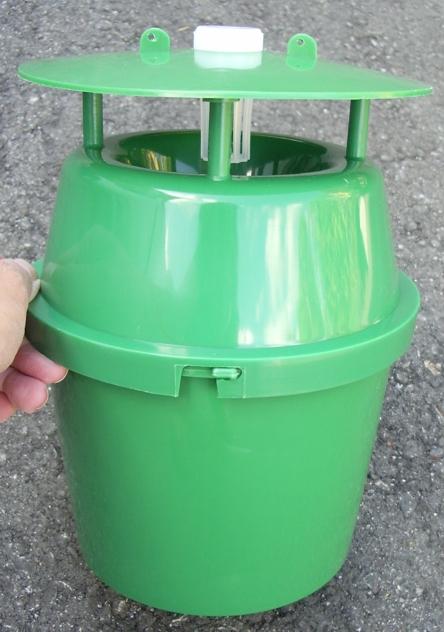
The IPM lab monitors red clover casebearers throughout the Peace Region. Pheromone traps and sweep-net collections help us monitor the moth flight period, the presence of mature larvae and densities in commercial fields of clovers.  The pheromone traps consist of a commercially available green unitrap, a pheromone lure (Otani, Mori, Evenden) as bait for the males and enclose a Vapona strip to kill and retain the specimens for later identification and counting (Fig. 2).  


http://www.semiochemical.com/unitrap.jpg
Figure 2. Green unitraps mounted singly on posts at the edge of a field are used for pheromone trap monitoring of male clover casebearer moths.
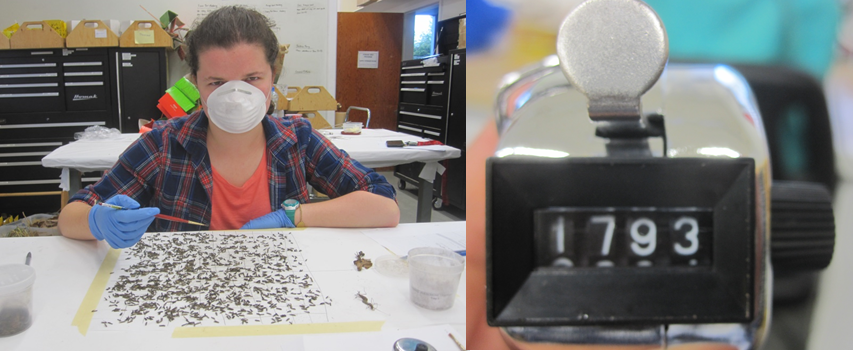
In the span of one week some traps can catch over 1000 casebearers! The casebearers are retrieved then later counted by summer students (Fig. 3) who wear gloves and dust masks to protect against the insecticidal vapona strip and inhalation of the tiny scales of the moths which coat the inside of the traps like dust.
C:\Users\Laura\AppData\Local\Microsoft\Windows\INetCache\Content.Word\Rccb!!.png
Figure 3. Summer students count and record the number of casebearers collected from each pheromone trap. This trap had 1793 casebearer moths.

For more information on red clover casebearers in the Peace River region, visit http://www1.agric.gov.ab.ca/$department/deptdocs.nsf/all/prm4587

Tuesday, 9 August 2016

This Week in the Lab - Prairie Pest Monitoring

Throughout this summer, the IPM lab at the Beaverlodge Research Farm performs weekly monitoring to support the Prairie Pest Monitoring Network (PPMN).  On a weekly basis, Staff perform outings to collect and deploy insect traps at canola fields in the area to help obtain data to represent the region. Target insects include flea beetles, diamondback moths, swede midge, red clover casebearers, bertha armyworm, wheat midge, grasshoppers, and lygus bugs (protocols and descriptions for each insect pest can be accessed at http://insectpestmanagement.blogspot.ca/p/blog-page.html).


These insects, by way of their feeding on leaves, buds, flowers, stems, and seeds cause economic levels of damage either by reducing quality or yield when outbreak populations are not detected or managed at the proper time. Thus, the weekly PPMN outings were necessary to monitor and assess arthropod species and densities throughout the growing season at various fields in the Peace River region. Monitoring species diversity and densities helps us understand the biology of these organisms and provides insight into interactions between the host plants they affect and even some of the natural enemies that help regulate their densities in field crop situations.  


In canola, sticky card and pheromone traps were deployed mid-May at commercial fields of canola just after they were seeded.  Monitoring continued weekly until traps were retrieved early in August as the seeds within canola pods were beginning to change colour.  On August 2nd, all of the traps at the two sites situated in the BC-side of the Peace River region were taken down.  On August 9th, all the traps at the seven sites in the Alberta-side of the Peace River region were taken down. The last picture shown below is from Wilson’s canola field (site id: 2016-005) on August 9th, 2016, when the mean canola growth rating stage was a 5.2 (Harper and Berkenkamp 1975).


Figure 1. Development of the canola at Site ID#2016-005 from May to August of 2016 (Upper L to Lower R) from seeding, cotyledon, rosette, flowering, and pod stages. Photo credits: Celine, Jadin, Emily and Kaitlin.


The past three months in the IPM lab have represented a roller coaster of experiences.  As the final weeks zoom by, I’d like to thank everyone at BRF for being so amazing, helpful, and for being a part of this journey. Here’s to mosquito bites and canola - Cheers everyone and wishing you all the best! :)

- Celine

Friday, 20 May 2016

2016 Staff at Beaverlodge!

This spring we again welcome students to the Farm.  These young people are learning about agriculture and gaining experience in our labs while accomplishing important tasks that allow our research to progress.  We're pleased that so many have come from so far!

Meet the IPM Program's new staff members and see what Hannah, Celine, Emily, Laura, Kaitlin, Jadin, Shelby, and Amanda are busy doing!

2016 Staff at Beaverlodge - Laura

Hello! My name is Laura and I just finished my third year of Environmental Science at the University of British Columbia. I love learning about all living things from trees to insects, and I especially enjoy searching for new bird species. My passion outside of biology is sailing: I race sailboats at the collegiate level and last summer I was a sailing instructor for kids. I am excited to work at the Beaverlodge Research Farm this summer and explore a new ecosystem! There isn’t as much sailing here on the prairie, but I am enjoying the Albertan birds.

Figure 1. Applying Tanglefoot to plastic.

This week, we are busy making emergence traps for wheat midge so we can collect the the newly emerging adults from the soil. To do this, we spread a sticky substance called Tanglefoot onto a plastic sheet (Figure 1) then we cut it into strips.  The strips will be mounted inside plastic buckets that have the bottoms cut off and will be pushed into the soil at our producer-cooperator fields. If the midges land on the sticky traps, they won’t be able to fly away and we will be able to collect them and determine how many have overwintered in the field.

I’ve learned that wheat midges are tiny flies that overwinter within cocoons in the soil. They emerge as adults over a 5-6 weeks period between mid-June to mid-July. They only live for four or five days but during that brief period the females lay eggs on the wheat flowers. When the eggs hatch, the larvae crawl within the spikelet (Figure 2) then feed upon the developing wheat kernel.  They are highly concealed larvae, existing and feeding within the spikelet then, once the weather turns damp, the larvae drop to the soil to form their cocoon in preparation for overwintering.

Figure 2. Structure of wheat plant and head (Image: http://www.odec.ca/projects/2009/adam9s2/index_files/image1207.jpg)

Typically, wheat midges are sampled using soil cores and by examining the plants for adults when they are laying eggs, but Amanda is doing research on other methods of monitoring this pest (as she writes about in her own post!).

Monday, 16 May 2016

2016 Staff at Beaverlodge - Amanda

Jadin and I heading back to the truck after a long day of work.


Happy field season! I’m back for another summer at the Beaverlodge Research Farm! This year I’m starting a Master of Science degree through the University of Alberta.  My project will examine the monitoring tools used to forecast wheat midge emergence timing and populations. I’ll be collecting data in commercial fields throughout Peace River region.

Emily and Celine collect soil cores amid the weeds and stubble.

Last week, I collected my first samples of the field season with help from Jadin, Celine and Emily. We collected soil core samples from field sites that were planted with wheat last year. The soil core samples are now being reared out back at the lab. Wheat midge overwinter in the soil then pupate and emerge as adults. In 3-4 weeks, wheat midge adults will emerge from the soil cores and I will be calculating how many wheat midge survived the winter. 


An adult wheat midge by Gilles San Martin via Wikimedia commons [CC BY-SA 3.0]

I’ve been busy this week phoning producer co-operators and preparing field sites. This is a job that we students don’t normally get to do, so I’m excited to take on more responsibility and learn new skills.  

- Amanda

Sunday, 15 May 2016

2016 Staff at Beaverlodge - Shelby

Hello!  My name is Shelby and this will be my third summer working at Beaverlodge Research Farm.  I recently completed a Bachelor of Science in Environmental Science at the University of British Columbia.  I am excited to say that I will be pursuing a Master’s degree in Biology this upcoming fall.


For my Master’s project I will be studying the natural enemies of wheat midge, an economically important pest of wheat.   There are two major categories of natural enemies that I will be looking at: predators and parasitoids.  As part of this project, this summer I am carrying out a study that is looking at the effect of crop rotation on ground beetle populations and the rate of predation on wheat midge larvae (Figure 1).  

Despite working at the Farm for so long, I find that there are always opportunities to learn new things while working at the station.  This past week, we seeded the plots that will be used as part of the crop rotation study and I was able to learn all of the processes involved in seeding.  Greg Semach, the Agronomy & Crop Adaptation Biologist at AAFC-BRF, showed me all of the process involved in seeding (Video clip below).  He explained how to load seed into the station’s Conserva Pak, how to change the seeding rate, and to how to clean the seed drill between seed types.  The entire process was incredibly interesting and I am lucky to have been able to see all of the hard work that goes into setting up and seeding all of the Farm’s research plot trials.

Figure 1. This 16-treatment trial includes wheat midge susceptible and tolerant varieties of wheat but also canola, peas and even a weed species. 


Greg Semach begins seeding the wheat into the first plot of the rotation study.  Greg explained that the knives on the Conserva Pak cut the seed rows as seeds are deposited down from the seed boxes via the tubs to fall into the seed rows.

2016 Staff at Beaverlodge - Emily

These past 2 weeks have been a rollercoaster of new information to me. So far I have learned about various insects I had no idea even existed like the Diamondback Moth (DBM) and the Flea beetle (FB). I have been introduced to both of these insects through the Prairie Pest Monitoring Network (PPMN) we do at the farm, where I’ve been shown how to catch them by using pheromone lures and sticky cards (Figure 1). Working outside in the field requires us to wear protective booties to prevent spreading soil disease such as clubroot or sclerotinia.

Figure 1. Inserting sticky card within diamondback moth pheromone trap.

Sclerotinia is a type of fungus that causes stem rot and is a problem for all Canadian canola farmers as it is one of the most destructive diseases. The fungus itself looks like a tiny golf tee-shaped mushroom that grows up to 2cm long and spreads up and down the stem of the canola plant, cutting off all nutrient and moisture flow. Symptoms of sclerotinia include bleaching and whitening of stems of the canola plant and leaves will turn light brown. Sclerotinia flourishes in damp weather because it spreads by releasing its spores after rainfall. The main control strategy for this destructive disease is foliar fungicides which still may be a long fight as the disease is known to attack over 400 different plant species at any stage of growth. 

PPMN monitoring involves more than just setting out traps on a weekly basis. Once all FB and DBM traps are collected, the sticky cards need to be examined and the insects are identified to species level so data can be collected.  This week, I was shown how to identify the various Flea Beetle species using a stereomicroscope (Figure 2).  The dominant species on our sticky cards is the Striped Flea Beetle (Phyllotreta striolata) but we also learned to identify the Hop Flea Beetle (Psylliodes punctulata) and the Crucifer Flea Beetle (Phyllotreta cruciferae). Overall, a good indicator for identifying the Flea beetle is looking for its enlarged femor on the third pair of legs.
Figure 2. Sticky card processing includes circling Striped flea beetles (~3mm long) while working under the scope.

Reflecting on the past 2 weeks of my first Co-op work term with my Natural Resource Science program, I am looking forward to coming out of this summer with an entirely new outlook on insects and more knowledge of the behind the scenes work of scientists in our lab. Thanks for reading.

- Emily