Showing posts with label This Week. Show all posts

Wednesday, 10 May 2017

Seeding underway at Beaverlodge!

The first research field plots of 2017 started to go into the ground at AAFC-Beaverlodge today!  The Agronomy and Crop Adaptation Program seeded their first agronomic field plot experiment (Fig. 1) of the year at the Beaverlodge Research Farm.

Figure 1. Research field plots being seeded using the Conserva-Pak seeder (9" row spacing) at AAFC-Beaverlodge (N55° by W119°) on May 10, 2017.
Despite wet spring conditions, this area of the research farm was fairly dry today.  The forecast is for more rain soon so the Agronomy and Crop Adaptation Program is doing their utmost to get the many agronomic trials and breeding plots into the ground.  They also manage and farm the interplot areas plus past and future research plot areas by maintaining them in rotation.  All the many experiments and plant breeding lines that are sown annually at the Beaverlodge Research Farm represent critical data because it arises from Canada's most northerly Agriculture and Agri-Food Canada site.  

It's also a very special year at the Beaverlodge Research Farm - it's our Centennial which means we mark 100 years of field plot data and all the effort and intellect that continues to make it all happen!

Watch for more as the growing season progresses!  Also mark your calendar for July 14, 2017, when the Beaverlodge Research Farm celebrates the Centennial year with an Open House for the general public to come join us!

Meet our students: Welcome back Jadin!

Hello! My name is Jadin, and I am back for another busy summer at the Beaverlodge Research Farm!

I recently completed a Bachelor of Science at the University of Alberta. This will be my fourth summer working in the IPM lab. Despite not being too comfortable around insects when I first started, I quickly developed a new appreciation for our little friends (Figure 1). Last July, during the annual Peace Canola Survey, I was able to travel to Fort Vermilion (Figure 2) and witness many interesting things such as aerial spraying!

Figure 1. Jadin (Left) holding a grasshopper nymph while Kaitlin looks on.
Figure 2. Jadin sweep-net surveying in canola near Fort Vermilion AB in 2016.
My first week back has been spent gearing up to start monitoring again this field season and introducing our new students (Charlotte, Cameron and Rebecca) to many of the projects we have going on in our lab. During my time at the Farm, I have had the opportunity to learn an immense amount of information about different insects and the crops grown in the Peace River region. I am excited to see what this summer has in store!

Meet our students - Welcome back Kaitlin!

Hi, my name is Kaitlin Freeman and this is my fourth summer returning to work at the Beaverlodge Research Farm

I just completed my second year of my Bachelor of Science in Registered Nursing at Grande Prairie Regional College. I am very excited to be involved with the Integrated Pest Management program once again this summer, and I am looking forward to expanding my existing knowledge on some of the common pests we monitor in the Peace River Northern Alberta region such as; Flea beetles, Diamondback Moths, Bertha Armyworm, Wheat Mmidge, and Red Clover Casebearers. 

This week has been all about preparing for the upcoming collecting season and teaching our new students about the different projects that will be taking place in our lab this summer (Figure 1). 


Figure 1.  Kaitlin supervising pheromone trap set up near Beaverlodge AB in 2017.

Meet our students - Welcome back Amanda!

This is Amanda –I’m back for another field season (i.e., my fifth here at the Beaverlodge Research Farm)! 

I will be continuing my M.Sc. degree studying wheat midge monitoring this year. I have another field season of data to collect. If you don’t remember how I started last field season, you can read that post here

I’ve been busy even though I’ve been away from the Farm for the past few months. A graduate student’s life is full of data analysis, writing reports and taking classes when we’re not out in the field but sometimes we get to do something fun. I recently participated in the finals of the 3 minute thesis competition at the University of Alberta. If you are interested in learning a bit more about wheat midge research you can watch it here:


I’m looking forward to another field season here at the Farm researching wheat midge monitoring!
Figure 1. Enjoying some of Alberta's great views during my down time (Photo: S. Dufton).

Meeting our students - Welcome back Shelby!

Hello again!  My name is Shelby Dufton and I am currently completing my Master’s degree at the University of Lethbridge. This will be my fourth summer at the Beaverlodge Research Farm.  I am very excited to be back for the second field season of my project.

I’ve been away in Lethbridge for the last 8 months processing some of the data I collected in 2016, completing my coursework, and giving presentations.  The bulk of my winter work has been to identify the beetles I collected from my plot trial last summer.  In total, we collected approximately 8,200 beetles, over half of which were ground beetles.  This is great to see observe because many ground beetles are known to be predators of insect pests.  This includes the pest insect that my project focuses on, the wheat midge.  If you’d like to learn more about ground beetles or wheat midge click here and here.

Figure 1. Shelby visits AAFC-Saskatoon in March 2017.

Figure 2.  Shelby taking a break somewhere in Alberta.


Meet our students - Introducing Charlotte!

Hello! My name is Charlotte and this will be my first summer working in the IPM lab at the Beaverlodge Research Farm. I’m currently completing my Bachelor of Science degree in Health Studies at the University of Waterloo. Because I’m in the university’s co-op program, I have been alternating between four months of school and four months in a job placement since my second year. I’m mid-way through my B.Sc. now. I’m hoping this summer will allow me to utilize some of the skills I’ve acquired through past work terms and allow plenty of opportunities for me to learn lots of new things. 

Although we have only been at the Farm for a week, there has been lots of new information thrown at us and work to be done. For example, myself and some of the other students set up weekly monitoring sites for flea beetle and diamondback moth traps at two locations on the Beaverlodge Research Farm (Figure 1). At each of our sites, a transect of five sticky cards (each 25m apart) were deployed. Each sticky card is positioned a few centimetres above the soil surface using a small wooden stake pounded into the ground. We also set up two diamondback moth pheromone traps (50m apart) positioned ~1m above soil surface using a wooden stake.  What makes these traps extra special is the pheromone lure hung inside the trap designed to release a species-specific pheromone plume into the air to attract males. From this point on, we will retrieve and deploy need traps on a weekly basis to determine the seasonal activity levels of both flea beetles and diamondback moth. 

I also had the opportunity to go out with one of my fellow coworkers, Amanda, and help her collect soil cores for the wheat midge project. Amanda has worked quite a few summers at the Farm and was able to offer a lot of pointers to a newbie like me. Most importantly, she talked about the importance of wearing Tyvek boot covers over my shoes. This is especially important with the cooperator-growers’ fields as we must protect all fields from plant pathogens in the soil (i.e., to prevent the spread of clubroot). Upon arrival at any grower’s field, we don new boot covers as we emerge from the vehicle.  These same booties are carefully removed as we return to the vehicle to depart.  

Overall, I had a very enjoyable first week in the IPM lab! I have already been exposed to a lot of new information and I’m excited to learn more as the summer progresses. 


Figure 1. Rebecca, Cameron and Charlotte (L to R) setting up diamondback moth pheromone traps near Beaverlodge AB in May 2017.


Meet our students - Introducing Cameron!

Hi! My name is Cameron and I am one of the new IPM students this year at the Beaverlodge Research Farm. I am currently studying Environmental Science at the University of Guelph, majoring in resource management. I am going into my second year in September, but taking a women’s studies course over the summer, just out of personal interest. I started out my university career in the Arts and Science program where you pick two minors - one in the Arts and one in the Sciences. I do have a very strong interest in the Humanities as well as the Sciences but I finally decided I wanted to specialize more in the sciences, and here I am!

This week we set up flea beetle and diamondback moth traps. The flea beetle traps are bright yellow sticky cards twist-tied onto little stake. 5 of them are set up, 25 meters apart, along the edge of a field. The diamondback moth traps are triangular-folded cardboard traps tied to the top of a wooden stake hammered into the ground. Two of these pheromone traps are set up in each field, 50 m apart. When we set up the pheromone traps, we tie a little grey rubber septum containing pheromones, a semio-chemical intra-species attractant for male moths. They follow the pheromone plume released by the rubber septum then the males get trapped on the sticky card positioned inside the triangular trap.  The sticky card is then removed on a weekly basis in order for us to count and record their relative numbers. 

We also helped Shelby with her natural enemies of wheat midge project.  We sieved soil containing overwintered wheat midge cocoons then looked through a dissection microscope to pull out both live and dead larvae and count them. I really enjoy looking through the microscope, I find it very meditative. We also learned a lot about clubroot. I went and did some research on my own to bring back to the other IPM students.  In terms of this cruciferous disease, the main management practices include sanitation of tools and wearing Tyvek booties to prevent its spread. 

All in all, I am very happy with how my first week went, and I look forward to the coming ones. 
Figure 1. Cameron processing overwintered wheat midge cocoons in the IPM lab at Beaverlodge AB in May 2017.

Meet our students - Introducing Rebecca!

Hi everyone! My name is Rebecca and this is my first summer working at the Beaverlodge Research Farm in the Integrated Pest Management Lab. 

I just finished my 4th year at the University of Alberta where I am pursuing a Bachelors of Science degree with a major in Biological Science and a minor in Earth and Atmospheric Science. Growing up in a small farming town nearby called, I have found an interest in agriculture, animals and working outdoors. Having worked with an applied research association before, I enjoy field work very much and am familiar with some of the work we do at the Farm. 

In the first week, we assembled and deployed traps for diamond black moths and flea beetles. The diamond black moth traps consist of a card covered in a sticky substance called tanglefoot and a lure that contains a pheromone designed to attract male moths. Flea beetle traps consist of a yellow sticky card that is set just about the ground level. Within the next few weeks, we will be deploying more traps for a variety of field crop insects.

I look forward to gaining more experience and learning a lot of new things this summer. I am very excited to be working on the Farm and am ready for a busy summer ahead!


Figure 1. Rebecca hunting for overwintered insects near Falher AB in May 2017.

Wednesday, 31 August 2016

This Week at the Farm - Good luck to all our IPM Students! (August 31, 2016)

This week the IPM Program bid farewell to all our summer students.  Wheat and canola still ripens in the field but our students are heading back to complete their degrees!  

We wish our students good luck with their Fall studies and thank them again for their many contributions!

2016 IPM Program's Staff included (L to R) Amanda, Shelby, Jadin, Kaitlin, Celine, Emily, Hannah and Laura.

Friday, 12 August 2016

This Week At the Farm - Red Clover Casebearer Monitoring

RCCB Post
By Laura
The red clover casebearer (Fig. 1) is a small, metallic green moth belonging to the Family Coleophoridae.  The larval stage of the red clover casebearer (Coleophora deauratella) feeds on the contents of clover florettes and eventually the developing seed.  Three species of Coleophora have established in Canada; C. deauratella utilizes red and alsike clover, C. mayrella utilizes red and alsike clover, and C. trifolii utilizes sweet clover. All three species create cases from the floral or seed pod structures of the host plant they utilize.  The larval stage constructs the “case” from its host plant which is worn and carried much like a snail in its shell, hence the common name of “casebearer”.  In the fall, the red clover casebearer moves from floral structures it feeds upon to the ground, carrying its case.  When conditions prompt overwintering, the red clover casebearer retreats within its case and seals the opening with silk.  In the spring, the red clover casebearer can emerge and move in order to find suitable spring conditions.  The larva then pupates within its case and is observed to begin to fly by mid-June in the Peace River region, typically flying over a 6-8 week period.  The metallic, green micro-leps seek their host plant, feeding upon nectar and they lay their eggs on the host plant.  
Figure 1. Red clover casebearer (Coleophora deauratella) larva and adult. The larva creates a case which it wears until it becomes an adult. Image sources: http://www.ukmoths.org.uk/species/coleophora-deauratella/


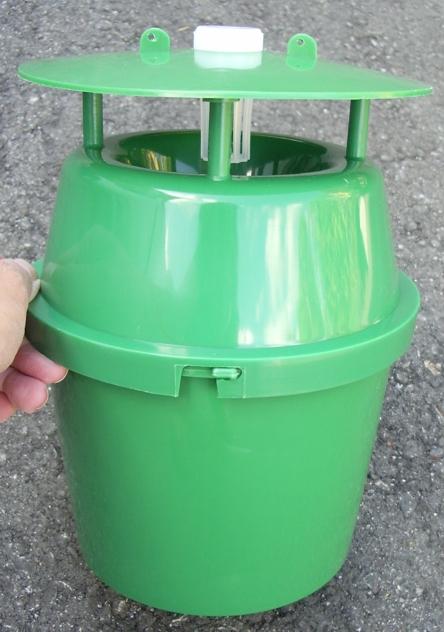
The IPM lab monitors red clover casebearers throughout the Peace Region. Pheromone traps and sweep-net collections help us monitor the moth flight period, the presence of mature larvae and densities in commercial fields of clovers.  The pheromone traps consist of a commercially available green unitrap, a pheromone lure (Otani, Mori, Evenden) as bait for the males and enclose a Vapona strip to kill and retain the specimens for later identification and counting (Fig. 2).  


http://www.semiochemical.com/unitrap.jpg
Figure 2. Green unitraps mounted singly on posts at the edge of a field are used for pheromone trap monitoring of male clover casebearer moths.
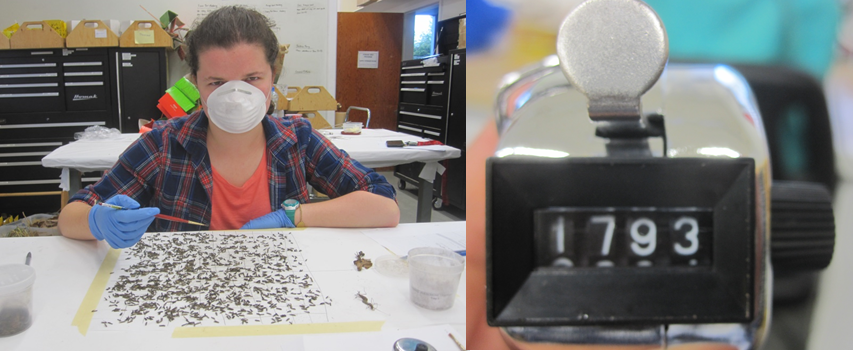
In the span of one week some traps can catch over 1000 casebearers! The casebearers are retrieved then later counted by summer students (Fig. 3) who wear gloves and dust masks to protect against the insecticidal vapona strip and inhalation of the tiny scales of the moths which coat the inside of the traps like dust.
C:\Users\Laura\AppData\Local\Microsoft\Windows\INetCache\Content.Word\Rccb!!.png
Figure 3. Summer students count and record the number of casebearers collected from each pheromone trap. This trap had 1793 casebearer moths.

For more information on red clover casebearers in the Peace River region, visit http://www1.agric.gov.ab.ca/$department/deptdocs.nsf/all/prm4587

Tuesday, 9 August 2016

This Week in the Lab - Prairie Pest Monitoring

Throughout this summer, the IPM lab at the Beaverlodge Research Farm performs weekly monitoring to support the Prairie Pest Monitoring Network (PPMN).  On a weekly basis, Staff perform outings to collect and deploy insect traps at canola fields in the area to help obtain data to represent the region. Target insects include flea beetles, diamondback moths, swede midge, red clover casebearers, bertha armyworm, wheat midge, grasshoppers, and lygus bugs (protocols and descriptions for each insect pest can be accessed at http://insectpestmanagement.blogspot.ca/p/blog-page.html).


These insects, by way of their feeding on leaves, buds, flowers, stems, and seeds cause economic levels of damage either by reducing quality or yield when outbreak populations are not detected or managed at the proper time. Thus, the weekly PPMN outings were necessary to monitor and assess arthropod species and densities throughout the growing season at various fields in the Peace River region. Monitoring species diversity and densities helps us understand the biology of these organisms and provides insight into interactions between the host plants they affect and even some of the natural enemies that help regulate their densities in field crop situations.  


In canola, sticky card and pheromone traps were deployed mid-May at commercial fields of canola just after they were seeded.  Monitoring continued weekly until traps were retrieved early in August as the seeds within canola pods were beginning to change colour.  On August 2nd, all of the traps at the two sites situated in the BC-side of the Peace River region were taken down.  On August 9th, all the traps at the seven sites in the Alberta-side of the Peace River region were taken down. The last picture shown below is from Wilson’s canola field (site id: 2016-005) on August 9th, 2016, when the mean canola growth rating stage was a 5.2 (Harper and Berkenkamp 1975).


Figure 1. Development of the canola at Site ID#2016-005 from May to August of 2016 (Upper L to Lower R) from seeding, cotyledon, rosette, flowering, and pod stages. Photo credits: Celine, Jadin, Emily and Kaitlin.


The past three months in the IPM lab have represented a roller coaster of experiences.  As the final weeks zoom by, I’d like to thank everyone at BRF for being so amazing, helpful, and for being a part of this journey. Here’s to mosquito bites and canola - Cheers everyone and wishing you all the best! :)

- Celine

Friday, 22 July 2016

So far in our monitoring.....

What we're seeing so far in our field monitoring.....


We finished our Annual Canola Survey of the Peace on July 8th but we are processing the samples from the 156 sites.  Please watch our IPM Lab Blog though – I will post our survey results there first.

Earlier this spring, there were cutworms and fields in the Peace were sprayed to try and manage that – I have no idea the number of acres though.  To date, our monitoring has shown low DBM and BAW pheromone count interceptions.  Wheat midge was forecasted to be lower populations through most of the entire Peace this season, however, midge flight synchronized fairly well with wheat anthesis in the south Peace.  We have seen some higher lygus bug numbers in some of our canola survey samples but the persistent rain throughout June-present has been a major factor in all our field crops.  More specifically, we aren’t seeing the typical nymph densities that we’d expect in the canola so far (because we know many have died owing to rain falling every 4-6 days from bolting through to early flowering) – stay tuned for the survey results though.  Grasshoppers are present but the situation is nowhere near the high risk originally forecasted back in January for the Peace. 

Almost all the fields we’ve seen around the south and north Peace have received some fungicide whether it’s been wheat, peas, or canola.  As Jim notes, producers are sometimes keen to tank-mix insecticide with the fungicide application and only the agricultural industry people will know those statistics on what product has been sold so far this season. 

From what I’ve seen so far, I would have expected a bit of grasshopper spraying by now and the next 10 days of heat and sun may bring about some spraying for Lygus but most canola will be at the pod stage by then and surely with the heat.  Overall, there are some very nice crops are out there despite some water damage.  Apart from cutworms, it hasn’t been a big insect pest outbreak year so far in the Peace.

Monday, 18 July 2016

Rearing parasitoids that attack Lygus

As mid-June approaches, Lygus in the Peace Region will be starting to lay their eggs into the stems and leaves of canola, alfalfa, and other plants. Later in the summer, when then the canola and other crops are more developed, adults and nymphs (Fig. 1) can damage crop yields when they feed on the juicy plant material of these crops. They pierce through the plant tissues with their sucking mouthparts- which often leave visible lesions on stems, buds, flowers and pod surfaces. Buds and flowers drop as a result and the seed pods often turn brown and shriveled from being fed on. The economic damage on canola in the Peace region is all caused by Lygus species native to North America.
Figure 1. Lygus nymph on the left and adult Lygus on the right (image retrieved from http://www1.agric.gov.ab.ca/$department/deptdocs.nsf/all/agdex741).

Lygus can be pale green to reddish-brown to black and have a distinct V-shape centered on their dorsal side (Fig. 1). Lygus overwinter as adults.  Theyemerge early in spring.  Canola is most susceptible to damage from Lygus at late flowering through the early pod stages.
The phenology of Lygus varies by region with 2-3 generations per year in the south of the Canadian prairies to only one generation per year in the Peace River region.  Lygus feeding damage will depend upon growing conditions. Abundant rainfall helps canola compensate, whereas hot, dry growing conditions favour Lygus development and often result in high populations capable of causing damage and yield losses.  If canola fields are adjacent to hay fields, early season monitoring of Lygus densities within the alfalfa can often help growers anticipate Lygus in bolting and early flowering canola.
The economic threshold for Lygus in canola varies by canola crop stage and is applied at late flower or early pod (Table).  It depends on sweep-net monitoring at multiple sites within a field and counting both adults and nymphs (3rd-5th instar stages). When densities exceed the economic threshold is exceeded registered foliar-applied insecticides are used to reduce feeding damage and protect the developing pods and seeds which then results in quality and yield being maintained.  There are a number of natural enemies that help reduce and regulate Lygus populations; notable wasp parasitoids include species from the Family Mymaridae and Braconidae.  In North America, the braconid, Peristenus pallipes has been reared from Lygus lineolaris and L. keltonii as well as L. shulli. A potential biological control agent also worth mentioning is Peristenus digoneutis which is a parasitic wasp or European origin that can attacks nymphal stages of Lygus rugulipennis  Poppius but has shown a degree of host preference for North American species of Lygus and has been released to in eastern Canada in strawberry production systems.   Historically, Peristenus digoneutis was released on the Canadian Prairies in the 1970’s but failed to establish in detectable numbers.  Efforts still continue to investigate P. digoneutis as a biocontrol agent for Lygus found in canola grown in Canada.

Figure 2.  Peristenus digoneutis here is shown laying an egg in a lygus nymph (image retrieved from: http://www.biocontrol.entomology.cornell.edu/parasitoids/peristenus.php ).
In our lab, we have prepared Peristenus rearing cages and mass collections were performed during the last week of June.  Mass collection involves sweeping the canopy then retrieving live specimens back for processing.  The density of Lygus is recorded and nymphs are isolated for rearing.

Peristenus wasps attack and lay an egg within 1st-2nd instar stages of Lygus nymphs (Fig. 2).  Once the egg hatches, the Peristenus larva develops within the body of a Lygus nymph so we rear the nymphs until they either mature to adults or a Peristenus larva emerges from the host to then drop down to the soil and spin its cocoon (Fig. 3).  We monitor the number of Peristenus cocoons that arise from the Lygus nymphs then the cocoons will be transferred to collaborators at AAFC-Lethbridge who will continue to rear and obtain the live wasps the following spring.

Figure 3.  Peristenus rearing cages at Beaverlodge Research Farm.

Sources:
Haye, T., et al. "Controlling Lygus Plant Bugs (Heteroptera: Miridae) with European Peristenus relictus (Hymenoptera: Braconidae) in Canada – Risky Or Not?" Bulletin of Entomological Research 96.2 (2006): 187-96.

Friday, 17 June 2016

Wheat midge pheromone trapping

This week at the farm: wheat midge monitoring

Our wheat midge monitoring will be getting into full swing very quickly.  Make sure to check out the 2016 Wheat midge forecast map and read the protocol on wheat midge. 

This week we have a short comic to help you better understand wheat midge pheromone trapping and what we can do with this tool. In the coming weeks look forward to learning why this pest is so important to monitor.

Page 1 (click to enlarge)
Page 2 (click to enlarge)

Thursday, 16 June 2016

2016 Natural Enemies Project

There has been much going on so far this summer with our Wheat Midge Natural Enemies Project.  So far, we have seeded our plot trial and have been collecting samples from the plots using a method called pitfall trapping.  This is similar to what Hannah described here for the pea leaf weevil but these traps do not use a lure. The pitfall traps used for this study are comprised of two containers and a funnel made out of the top portion of a 2-Liter pop bottle.  As they are walking along the soil surface, arthropods fall into the funnel and slide down into the trap, which contains a mixture of antifreeze and water.  This solution kills and preserves them until we collect them each week.


Figure 1.  (A) The pitfall trap sits flush with soil in the middle a row in each plot. (B) The pitfall sample after the inner container has been removed.  Specimens are preserved in antifreeze solution which is the pink liquid that can be seen in the photo.

The pitfall traps collect a variety of arthropods which includes a fascinating array of beetle species.  The beetles we collect come in all shapes and vary from 2 mm to 4 cm in length.  Some of the most exciting of these are the beetle predators which are one of the main focuses of this study.  The goal of this project is to provide a unique comparison of beetle diversity and the rotation practices utilized by growers in the Peace River region.


Figure 2.  The biodiversity of beetles collected in wheat can be seen in this sample from the 2015 pitfall trap collections.

Ground Beetles
Carabidae, commonly known as ground beetles, is the largest family in the suborder, Adephaga, which comes from the Greek adephagos or ‘gluttonous.’  Gluttonous goes a long way in describing this family, as ground beetles are voracious feeders and often are cited as important predators.  Ground beetles are known to feed on aphids, cabbage root flies, Lepidopteran larvae, and many other pest species.  Carabid beetles make up the vast majority of the beetles we pick up in our pitfall traps.  Keep an eye out for them in the field; they have long slender legs made for running and vary in color.  Dark coloration generally denotes nocturnal species and metallic coloration usually indicates species that are active during the day.


Tiger Beetles
Though they may look quite different, tiger beetles are a sub-order in the Carabidae family.  Tiger beetles have long, sickle shaped mandibles (mouthparts made for chewing) and bulging eyes.  The larval stage of these beetles is known to create tunnels in the soil substrate.  There, they lie in wait to ambush prey at the opening of the tunnel.  When their prey walks by, the larva grabs it and drags it down to the bottom of the tunnel to feed.  The adults of these species are rapid fliers and have distinctly long legs that allow them to run quickly over the soil surface.    


Rove Beetles
Staphylinidae, or rove beetles, are another important family in terms of predation.  Rove beetles typically have shortened elytra that do not completely cover their abdomen.  Elytra are the hardened forewings that characterize all beetles.  Having shortened elytra allows rove beetles to maneuver more readily in the field.  However, there is a trade off - shortened elytra expose them to a greater risk of desiccation which makes them dependent on humid habitats.  Rove beetles are great predators and can even be parasitic.  Check out this link to see one of the parasitic rove beetles (Aleochara spp.) that emerged from a cabbage root fly pupa that we collected in October 2015.


-Shelby