Showing posts with label 2015. Show all posts

Sunday, 18 October 2015

2015 Peace River Region Annual Canola Survey

2015 Peace River Region Annual Canola Survey
Jennifer Otani1

1  Beaverlodge Research Farm, Agriculture & Agri-Food Canada, P.O. Box 29, Beaverlodge AB, jennifer.otani@agr.gc.ca.

2  Saskatoon Research Centre, Agriculture & Agri-Food Canada, 107 Science Place, Saskatoon SK.
3  BC Pest Monitoring Contactor, Dawson Creek BC. 
4  Canola Council of Canada, Beaverlodge AB.


The 2015 Annual Peace Canola Survey was completed by Agriculture & Agri-Food Canada staff based at Beaverlodge1, and Saskatoon2.  Samples were also kindly collected with help from the BC Pest Monitoring Contractor, Arlan Benn3, and Canola Council of Canada Student Assistant, Trina Drummond4.


Since 2003, the annual survey has been performed with the main objectives of (i) collecting insect pest data throughout the region and (ii) to detect introduction of the Cabbage seedpod weevil into the Peace River region.  In 2015, a total of 162 canola fields were randomly selected.  Fields were spaced approximately 10 km apart and surveying was performed through the main canola producing areas of the BC and Alberta Peace during early- to mid-flower stages.  Unfortunately, fewer fields were sampled north of 57.3° in 2015 (i.e., near Manning, LaCrete, Fort Vermilion and High Level) owing to sparse and patchy canola fields that suffered from repeated frost events and severe drought.  In 2015, sweep-net monitoring was performed in 162 commercial fields of Brassica napus (e.g., each field ≥80 acres in size) using 50 - 180° sweeps on the following dates in these areas:
  • July 5 near Grimshaw, Manning, Hawk Hills, LaCrete.
  • July 6 near Valleyview, Guy, Falher, Nampa, Peace River, Jean Cote, Girouxville.
  • July 7 near DeBolt, Grande Prairie, Bezanson, Teepee Creek, Wanham, Rycroft, Sexsmith.
  • July 8 near Fairview, Blue Sky, Berwyn, Tangent, Watino, Eaglesham, Ridge Valley, Kleskun Hills, Wembley, LaGlace, Dawson Creek, Rolla, Rose Prairie, Montney, Beaverlodge, Valhalla, Woking, Spirit River, Dunvegan, Hines Creek.
  • July 9 near Rolla, Doe River, Clayhurst, Farmington, Taylor, Baldonnel, Fort St. John, Golata Creek.
Sweep-net samples were frozen then processed to generate data for 16 species of arthropods.  Lygus specimens were identified to all five instar stages. The 2015 summary includes seven economically important pests of canola reported from 162 surveyed canola fields:


  1. Lygus (Miridae: Lygus spp.) were the most common insect pest observed in sweep-net samples collected in our 2015 surveying.  Lygus populations of ≥5 adults plus nymphs per 10 sweeps were observed in 40.1% of fields surveyed (Figure 1 and Table 1; N=162 fields).  Densities of ≥15 adults plus nymphs per 10 sweeps were recorded in 7.4% of fields surveyed (Figure 1 and Table 1).


Figure 1. Contoured map reflecting Lygus densities (adults+nymphs) in sweep-net samples collected between July 5-9, 2015, in canola fields throughout the Peace River region.


There were zero Lygus present in only 2.5% of fields surveyed (Table 1) whereas 21.6% of the canola fields contained only adult Lygus versus 75.9% of the fields that were populated by both adults and nymphs (Table 2).  Note that all nymphs collected during surveying were expected to have matured into new adults by the early pod stage.  Areas highlighted yellow, orange or red in Figure 1 may contend with Lygus with the continuation of dry, warm growing conditions typically favouring the development of Lygus nymphs to adults.  


Table 1.  Summary of Lygus densities occurring in surveyed fields in 2015.  


Lygus bugs per 10 sweeps
Number of fields
Percent of fields sampled
≥15.0
12
7.4%
10.1-15.0
11
6.8%
5.1-10.0
42
25.9%
0.1-5.0
93
57.4%
0
4
2.5%
Sum
162
100%
Table 2.  Proportion of fields surveyed containing zero Lygus, only adults, only nymphs or adults plus nymphs in commercial fields of canola in 2015.  


Lygus stages collected
Number of fields
Percent of fields sampled
No Lygus
4
2.5%
Adults only
35
21.6%
Nymphs only
0
0%
Adults + Nymphs
123
75.9%
Sum
162
100%


  1. Grasshoppers were present in 35 of 162 canola fields surveyed.  Late-instar and adult stages of two-striped, clearwinged, lesser migratory, and red legged grasshoppers were present in the sweep-net samples (listed from most numerous to least) in canola growing near Valleyview, Eaglesham, Whitemud Creek, Manning, Bluesky, Blueberry Mountain, Peace River, Ridge Valley, DeBolt, Rose Prairie, Rycroft, Hotchkiss, Savannah, Berwyn, Bonanza, Farmington, Beaverlodge, Blue Hills, Teepee Creek, Sturgeon Lake, Wembley, LaGlace, Poplar Ridge, Bridgeview, Dixonville, Tangent, Fairview, and Royce.


Click here to review the entire grasshopper protocol and biological descriptions.  Additional information related to grasshoppers can be located on Alberta Agriculture and Rural Development’s webpage located here or the BC Ministry of Agriculture’s webpage located here.


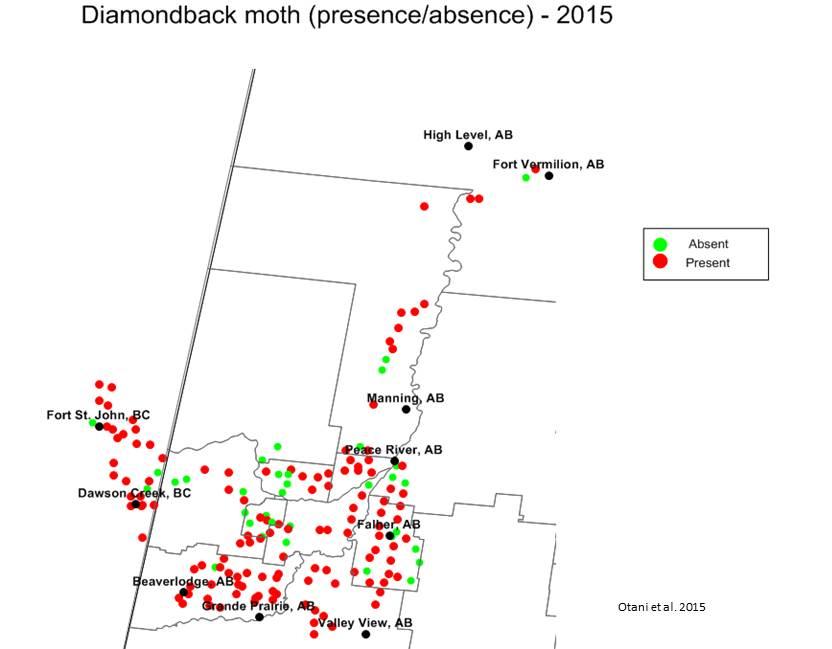
  1. Diamondback moth (Plutellidae: Plutella xylostella) were generally present in low numbers in the sweep-net samples (N=162 fields) in 2015.  Sweep-net monitoring is NOT recommended for this insect pest yet we collected a total of 672 specimens from 162 fields in 2015 compared to 230 specimens in the 206 fields in 2014 and 93.6% of the 672 specimens were DBM larvae.  Sites with higher numbers of DBM included Valleyview, Farmington, Ridge Valley, Baldonnel, Donnelly, Fort St. John, Beaverlodge, Blue Hills, and DeBolt.


It’s important to note that parasitoid wasps (e.g., Diadegma sp. and Microplitis sp.) were observed throughout the region and the presence of these natural enemies of DBM is strongly suspected to be keeping DBM densities relatively low.
Figure 2.  Presence/absence map reflecting distribution of diamondback moth (adults, larvae, pupae) occurring in sweep-net samples collected in canola from July 5-9, 2015.

  1. Root maggot (Delia sp.) adults were again prevalent in fields and were collected from 122 of the 162 sites surveyed throughout the Peace River region in 2015.  Numbers collected by sweep-net surveying ranged from 0.2-5.6 Delia sp. flies per 10 sweeps versus 0.2-10 flies per 10 sweeps in 2014 but growers should note – root assessments, rather than sweep-net monitoring, is recommended to accurately assess densities of root maggots.  More information related to root maggots in canola can be found by linking here.


  1. Normally, the annual canola survey is conducted during the initial weeks of the Bertha armyworm adult flight period so larval stages, if present, are typically very small and difficult to accurately detect and identify within the sweep-net samples.  Even so, seven of 162 fields surveyed contained early instar larvae tentatively suspected as Bertha armyworm larvae (e.g., Hawk Hills, Blue Hills, Valleyview, Guy, LaGlace and Scotswood).  It should also be noted that early instar larvae suspected as Salt Marsh Caterpillars were tentatively identified from three fields surveyed (e.g., Doe River, Clayhurst, Taylor).  


  1. Leafhoppers were observed in 69 of 162 fields yet densities were consistently low in our canola sweep-net samples in 2015.  The highest density was six per 50 sweeps in a canola field near Fort Vermilion and near Bezanson.  More information related to leafhopper biology and monitoring can be found by linking here.


  1. We are again happy to report that zero cabbage seedpod weevil (Curculionidae: Ceutorhynchus obstrictus) were observed in the 162 fields sampled in the Peace River region in 2015.  Approximately nine small weevils measuring <4mm in length and <20 beetles measuring <5mm in length were retained from the survey samples for forwarding to the National Identification System (AAFC-Ottawa) for species confirmation.


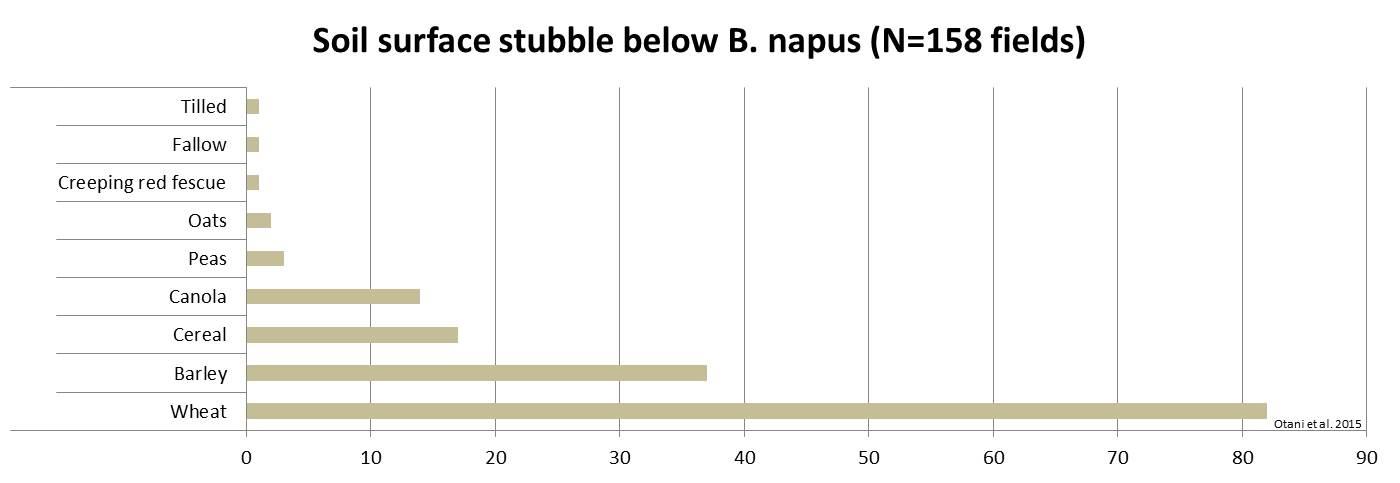
  1. Previous cropping data was recorded by visually inspecting the soil surface of surveyed canola fields.  Surface field trash was categorized then summarized in the figure below (Note: category “cereal” was used to describe fields where the previous crop was either barley or wheat yet no seed was readily observed nor was the straw sufficiently intact to determine the presence/absence of auricles).  


The most frequently observed soil surface stubble encountered beneath surveyed canola fields in 2015 was wheat stubble, followed by barley, residue that was characterized as “cereal”, canola, peas, oats with single fields of stubble remaining from creeping red fescue, left fallow, or tilled (N=158 fields).  


Figure 3. Field surface condition or stubble type observed in canola fields surveyed in the Peace River region in 2015.

THANK YOU to the following hard working AAFC staff who surveyed, processed, and mapped this data:  Owen Olfert2†∞, Ross Weiss2†∞, Shelby Dufton1†‡, Amanda Jorgensen1†‡, Holly Spence1†‡,  Andras Szeitz1†‡, Jadin Chahade1†‡, and Kaitlin Freeman1†‡.  

Finally, and MOST IMPORTANTLY, Thank you to our canola producers for allowing us to sample in their fields!  

Previous survey summaries can be accessed here.

Wednesday, 23 September 2015

2015 Lygus Caging Study

Back in June, we were busy preparing the Lygus Caging Study.  Our plants had grown to the late rosette stage so the cages needed to go up in order for us to examine the effect of 20 Lygus adults feeding on canola from bolting to harvest.  Click on the link below to view a video of how our great staff prepared our field plots!

https://drive.google.com/file/d/0B_1NQ60rRZGTTzZQMVVocHU4Nms/view?usp=sharing


Friday, 4 September 2015

Weekly Updates for 2015

The Prairie Pest Monitoring Network's final Weekly Update has been posted to: http://prairiepestmonitoring.blogspot.ca/

Good luck to our growers and thank you to the many people who contributed to monitoring in field crops across the prairies this season!

Wednesday, 2 September 2015

This Week at the Farm (Sept 2, 2015)

This week the IPM Program retracted down to permanent employees with the departure of our summer students.  Both the CARP Flea Beetle and ACIDF Lygus Caging field plot studies are still in the field ripening and the Wheat Midge Soil core sampling will begin once local wheat fields are combined.

We wish our students good luck with their Fall studies and thank them again for their many contributions.  
2015 IPM Program's Staff including (L to R) Jennifer, Holly, Jadin,
Kaitlin, Amanda, Shelby, and Andras.

Friday, 3 July 2015

2015 Peace Canola Survey!

Coming soon to a field near you.......

The Annual Peace Canola Survey has been performed by IPM Staff at AAFC-Beaverlodge since 2003.  This year, the survey began on July 5th.  Please watch for our dedicated staff members.  They'll be wearing tyvek booties, swinging sweep-nets, recording canola growth stages and underlying stubble types.

Check out the 2014 survey summary kindly posted by the Alberta Canola Producers Commission.

Here's what canola field number 1 looked like and it was growing near Grimshaw AB!

The first canola field surveyed as part of our 2015 Annual Peace Canola Survey!


Wednesday, 24 June 2015

This Week at the Farm (June 22, 2015)

June is a busy month here at the farm and this week we were busy preparing for the Lygus caging study. On Thursday, our team worked hard to get 24 caging tents up on the test plots for future Lygus storage.

It is important that the tents go up before the canola begins to bolt.   There are two cages per plot and three plots per replicate with four replicates -- one tent is an untreated control while the other cage will be treated with 20 live Lygus adults.  The objectives of this study are to compare Lygus feeding damage from bolting to harvest when the Lygus are allowed to feed and reproduce on either Westar an InVigor or a RoundUp Ready cultivar.

Once the cages are up, we then mass collect Lygus adults and they need to be sorted by species and sex in order to ensure that 10 males plus 10 females of the same species are introduced into the treated cages.  We also have to empty the cages prior to adding our test subjects.  In each plot, there are two cages: one cage receives 20 lygus adults while the other will be maintained insect-free for the rest of the growing season.


At harvest, our Staff then collects all the arthropods inside each cage - we do it by vacuuming!  We use vacuums and fabric to bundle the retrieved insect samples then we freeze everything so we can can sort it later.  In the Fall, each sample is processed to determine the species and instar stages of the recovered Lygus.  We also hand-harvest all the canola plants inside each cage so we can determine the yield and quality.  We then compare our harvest data to the recovered insect densities and stages.  We are most keen to examine the impact of the Lygus feeding on Westar but to also compare that data to the newer InVigor and RoundUp Ready cultivars.

Jadin

Friday, 12 June 2015

This Week at the Farm (June 12, 2015)

June is cutworm month and cutworm scouting is crucial at this time of the year.

Cutworms include several species of noctuids that feed on a broad range of host plants but they are not worms!  Cutworms are the larval stage of several species of economically important noctuids that can cause damage in prairie-grown crops including canola, mustard, wheat barley, triticale, peas, alfalfa, clover, timothy and several fescue species.  Some cutworm species prefer broadleaf to grass- or cereal-type host plants but some will consume whatever plant is available.

Cutworms overwinter as eggs and larvae so damage will occur in field crops from April until August, depending on the species.

Larvae feed by shredding or clipping leaves or stems of growing plants so seedlings can be highly susceptible.  Cutworm damage is characterized by missing seed rows or bare batches where plants have been consumed beneath the soil surface.  Wilted, drying or brown vegetation can indicate larval feeding occurring below the soil surface or within the crown of a plant.

This cutworm larva was found curled  up in the soil near the crown of a timothy plant near Falher, AB
One of the four objectives of the CARP Cutworm project is to document the species diversity and distribution of cutworms causing damage in our commercial fields.  For our lab, this includes collecting live larvae and rearing them.

These cutworms were collected in canola in a field near Peoria, AB
Cutworm larvae are hand-collected by IPM staff or by producers.  Once they arrive at our laboratory, each specimen is assigned an ID number in order to track their development.

Rearing then involves measuring, feeding, and changing each larva every 2-3 days.  Each larva is housed inside a plastic container (1oz) prepared with filter paper to regulate moisture in the container.  Every 2-3 days, each larva is provided with a prepared media containing antibiotics and nutrients specific to their needs.

This GIF shows a cutworm collected from wheat near Falher, AB feeding on a piece of media.

Each larva is photographed and measured as they develop.  This generates an image library that we will use to develop a tech-transfer document intended to help identify species of cutworm at different growth stages.

More information on the CARP Cutworm Project can be found here
More information on cutworm monitoring can be found here

Albertans can use the 2015 cutworm reporting tool to help us identify cutworm infestations which updates a live map.

-Shelby

Agronomy may never be the same!

This week, the Agronomy & Crop Adaptation Program's two Student Assistants received some special training!  After learning and helping with seeding, Emma and Carina were instructed on how to operate one of the ConservaPak seeders.  They began with some pathway seeding yesterday!

Training like this is important and it's given according to the skill and maturity of a Staff member.  Research plots seeders like the ConservaPak are major capital investments made within AAFC that have 10-30 years of research use.   The operation and use of these major pieces of equipment are critical to the research we perform BUT they don't move without properly trained operators who possess the technical skills and experience to capably drive them.

Carina and Emma aren't quite ready to seed our field research plots yet - but then again, they are learning and gaining experience to help get them there someday!

Congratulations on a pretty big step in your agronomic careers Carina and Emma!


Wednesday, 10 June 2015

Canola Scouting Guide

Field scouting is critical because it enables the identification of potential risks to crops. Canola production systems across the Canadian prairies will suffer insect pest outbreaks. However, the identification of these insect pests PLUS the application of established monitoring methods will enable growers to make informed pest management decisions.

This year we offer a generalized canola scouting chart to aid in-field scouting on the Canadian prairies. This guide contains hyperlinks to help growers learn more about some of our insect pests and how to monitor.

Whenever possible, monitor and compare to established economic thresholds so pollinators and beneficial arthropods are preserved.  Economic thresholds, by definition, can help growers avoid crop losses due to an insect pest.


Good luck with the growing season!


This, along with many other resources, can also be accessed at the Prairie Pest Monitoring blog.

Tuesday, 9 June 2015

June is Cutworm month!

We have ~143 cutworms and the majority came from the Guy/Falher area between Jun 3-5, 2015.  About 65% of the material we are shipping to AAFC-Saskatoon where we’ve requested they try to include them in future multiplex PCR or CO1 barcoding to identify the species x  host crop associations. 


Anyone seeding an annual into 2014 legume stubble should be carefully scouting for cutworms if they’re anywhere East of Wanham.  The absence of precipitation but warm temperatures mean that cutworm damage is showing up quite suddenly where other years moisture helps the plants grow quickly and tolerate cutworm feeding


Please report Albertan cutworm sites! 


Every entry is important because it helps us all estimate how much of a problem we have now and into 2016.  Once data entry occurs, your growers can be checking the live cutworm map located here.