Showing posts with label Red Clover. Show all posts

Wednesday, 9 February 2022

Winter 2022 and our IPM Team!

Our field research program at Beaverlodge hinges on technical support - these are people who implement the science we are fortunate to be supported to do in the Peace River region!

This winter, our program has new people hired who are rapidly learning a LOT about how to process and begin to identify the more than 110 arthropod species that are active in annual and perennial field crops  grown throughout the region. Learn more about Jordon, Vicky, Tessa, and Tanya. They join ShelbyAmanda, and me and we're the IPM Team for the winter of 2022!

Tuesday, 5 February 2019

Red clover casebearer in the Peace River region

We pulled together information related to the Red clover casebearer (Lepidoptera: Coleophoridae: Coleophora deauratella):


Other insect pest related information pertinent to perennial grass and legume seed production in Canada:
  • Alberta Forage Manual (2009; Ag-Dex120/20-1; ISBN 0-7732-6082-X; pdf version).  Includes Forage Insects and Natural Enemies of Forage Pest Insects chapters.
  • Arthropods of legume forage crops (2011; ISBN 978-0-9689321-5-5; pdf version).
  • Field crop and forage insect pests and natural enemies in western Canada (ISBN 978-1-100-25768-6; pdf version).
  • Cutworm field guide (2017; ISBN 978-0-660-08051-2; pdf version).
  • Information related to natural enemies in field crops - Western Grains Research Foundation is working with federal and provincial entomologists across the Canadian prairies to promote beneficial arthropods.  Growers are the target audience so check out the website and follow them on Twitter @FieldHeroes 

Saturday, 26 May 2018

Meet our students (2018) - Introducing Maya!

Hi!
My name is Maya Schmidt and I’ve just begun my second summer working at the Beaverlodge Research Farm.It’s my first time working with the IPM program.


I’ve recently finished my first year of my Bachelor of Engineering at the University of Alberta. I am eager to learn tons this summer and have already had fascinating experiences in my first few weeks of the job.  In the last couple of weeks, we’ve been setting up flea beetle and diamondback moth traps located at various growers’ fields around the county. The flee beetle traps are a double sided yellow sticky card – the yellow colour of the card is what attracts the flea beetles. The diamondback moth ones are set up as a delta trap, with a sticky card and pheromone lure inside to attract male moths. Recently, we collected the first set of cards which need to be collected and replaced every week. The cards are processed by inspecting them under a microscope. We identify and count the target insects on each trap.

The other new students and I have also been assisting the two graduate students, Amanda and Shelby, with processing their wheat samples.  Their experiments involve hand-threshing wheat head samples to identify and count wheat midge larvae infestation levels. Other collecting and processing involved red clover field trash where we are looking for overwintered weevils and red clover casebearers.
I hope to gain valuable experience, expand my scientific knowledge and perhaps step out of my comfort zone. It looks like it’s going to be an interesting summer!

Friday, 12 August 2016

This Week At the Farm - Red Clover Casebearer Monitoring

RCCB Post
By Laura
The red clover casebearer (Fig. 1) is a small, metallic green moth belonging to the Family Coleophoridae.  The larval stage of the red clover casebearer (Coleophora deauratella) feeds on the contents of clover florettes and eventually the developing seed.  Three species of Coleophora have established in Canada; C. deauratella utilizes red and alsike clover, C. mayrella utilizes red and alsike clover, and C. trifolii utilizes sweet clover. All three species create cases from the floral or seed pod structures of the host plant they utilize.  The larval stage constructs the “case” from its host plant which is worn and carried much like a snail in its shell, hence the common name of “casebearer”.  In the fall, the red clover casebearer moves from floral structures it feeds upon to the ground, carrying its case.  When conditions prompt overwintering, the red clover casebearer retreats within its case and seals the opening with silk.  In the spring, the red clover casebearer can emerge and move in order to find suitable spring conditions.  The larva then pupates within its case and is observed to begin to fly by mid-June in the Peace River region, typically flying over a 6-8 week period.  The metallic, green micro-leps seek their host plant, feeding upon nectar and they lay their eggs on the host plant.  
Figure 1. Red clover casebearer (Coleophora deauratella) larva and adult. The larva creates a case which it wears until it becomes an adult. Image sources: http://www.ukmoths.org.uk/species/coleophora-deauratella/


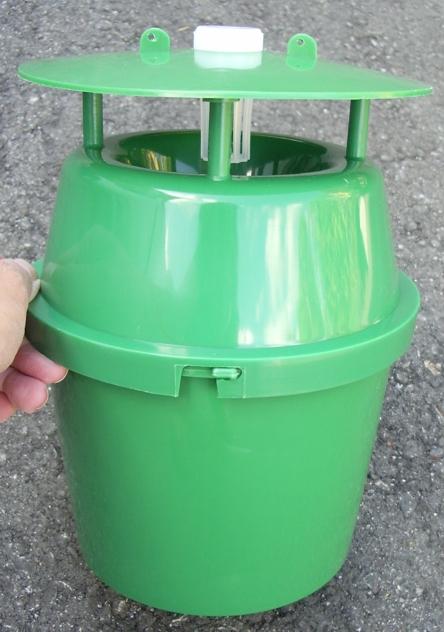
The IPM lab monitors red clover casebearers throughout the Peace Region. Pheromone traps and sweep-net collections help us monitor the moth flight period, the presence of mature larvae and densities in commercial fields of clovers.  The pheromone traps consist of a commercially available green unitrap, a pheromone lure (Otani, Mori, Evenden) as bait for the males and enclose a Vapona strip to kill and retain the specimens for later identification and counting (Fig. 2).  


http://www.semiochemical.com/unitrap.jpg
Figure 2. Green unitraps mounted singly on posts at the edge of a field are used for pheromone trap monitoring of male clover casebearer moths.
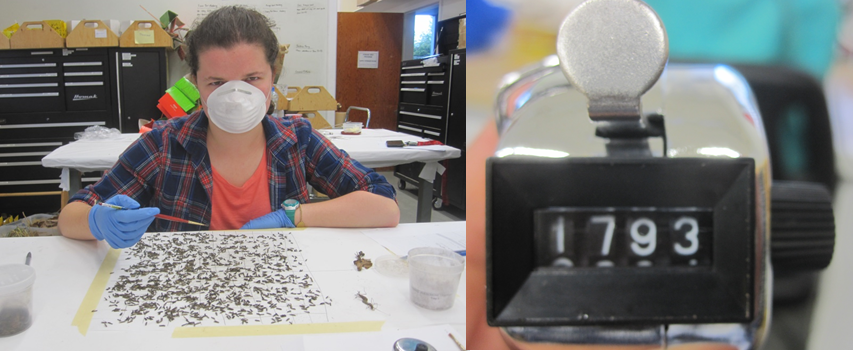
In the span of one week some traps can catch over 1000 casebearers! The casebearers are retrieved then later counted by summer students (Fig. 3) who wear gloves and dust masks to protect against the insecticidal vapona strip and inhalation of the tiny scales of the moths which coat the inside of the traps like dust.
C:\Users\Laura\AppData\Local\Microsoft\Windows\INetCache\Content.Word\Rccb!!.png
Figure 3. Summer students count and record the number of casebearers collected from each pheromone trap. This trap had 1793 casebearer moths.

For more information on red clover casebearers in the Peace River region, visit http://www1.agric.gov.ab.ca/$department/deptdocs.nsf/all/prm4587

Thursday, 14 May 2015

This Week at the Farm (May 14, 2015)

The IPM crew has been hard at work this week sorting through our sweep samples from 2014.  A total of 878 samples were collected in 2014 as part of our field research.  The processing and identification of arthropods within these samples often requires 2-6 hrs by trained Staff members.


IPM technician, Holly (left) and COOP Student, Amanda (right), are sorting through red clover sweep-net samples collected near Falher, AB in July 2014.  These samples provide an indication of species diversity and density within the region and allow us to monitor pest populations.


Each sample is sorted using paintbrushes into petri dishes by type of insect.  Of particular interest in red clover sweep samples like these are red clover casebearers, lygus, and various types of weevils.  We are also on the lookout for natural enemies such as parasitoids and predators.

-Shelby Dufton