Showing posts with label 2016. Show all posts
Showing posts with label 2016. Show all posts
Wednesday, 26 April 2017
Prairie Pest Monitoring Network 2017 Risk and Forecast Maps
The Prairie Pest Monitoring Network has posted the 2017 Risk and Forecast Maps for insect pests monitored throughout the Canadian prairies. Link here to access the Post and to view the downloadable maps.

Monday, 12 September 2016
Natural enemy of Cabbage Root Maggots - Aleochora bilineata (Coleoptera: Staphylinidae)
Beneficial arthropods are present in all field crops. On the Canadian prairies, several insect pests cause economic levels of damage but natural enemies play an important role in the regulation of all species. Diseases, parasites, parasitoids, and predators are all examples of natural enemies that will attack and regulate insect pest pests. Read on to learn more about these organisms and the importance of preserving them in field crop situations!
CANOLA
Cabbage root maggots are a multivoltine complex of up to three species including Delia planipalpis, D. radicum, D. floralis (Diptera: Anthomyiidae). The cabbage root maggot overwinters within a puparium and emerges in the spring. Data has shown that continuous cropping of canola on canola contributes to high populations of root maggot so crop rotation is the greatest tool to manage this insect pest whose larval stage feeds upon the canola root. The beneficial organism that attacks both the egg and pupal stages of the cabbage root maggot is Aleochora bilineata, a small staphylinid beetle which is both predator and parasitoid! Aleochora bilineata adults hunt and eat Delia spp. eggs but this beneficial organism also parasitizes Delia puparia so, instead of the fly emerging from the root maggot puparium, a beetle emerges - check it out below!
More information is available below from the new Insect Guide:


Also look up this scientific publication to learn more about Aleochora bilineata in canola production systems in Canada: Broatch J.S., Dosdall L.M., Yang R.C., Harker K.N., Clayton G.W. 2008. Emergence and seasonal activity of the entomophagous rove beetle Aleochara bilineata (Coleoptera: Staphylinidae) in canola in Western Canada. Environ Entomol. 37(6):1451-60.
CANOLA
Cabbage root maggots are a multivoltine complex of up to three species including Delia planipalpis, D. radicum, D. floralis (Diptera: Anthomyiidae). The cabbage root maggot overwinters within a puparium and emerges in the spring. Data has shown that continuous cropping of canola on canola contributes to high populations of root maggot so crop rotation is the greatest tool to manage this insect pest whose larval stage feeds upon the canola root. The beneficial organism that attacks both the egg and pupal stages of the cabbage root maggot is Aleochora bilineata, a small staphylinid beetle which is both predator and parasitoid! Aleochora bilineata adults hunt and eat Delia spp. eggs but this beneficial organism also parasitizes Delia puparia so, instead of the fly emerging from the root maggot puparium, a beetle emerges - check it out below!
More information is available below from the new Insect Guide:


Also look up this scientific publication to learn more about Aleochora bilineata in canola production systems in Canada: Broatch J.S., Dosdall L.M., Yang R.C., Harker K.N., Clayton G.W. 2008. Emergence and seasonal activity of the entomophagous rove beetle Aleochara bilineata (Coleoptera: Staphylinidae) in canola in Western Canada. Environ Entomol. 37(6):1451-60.
Wednesday, 31 August 2016
This Week at the Farm - Good luck to all our IPM Students! (August 31, 2016)
This week the IPM Program bid farewell to all our summer students. Wheat and canola still ripens in the field but our students are heading back to complete their degrees!
We wish our students good luck with their Fall studies and thank them again for their many contributions!
We wish our students good luck with their Fall studies and thank them again for their many contributions!
 |
| 2016 IPM Program's Staff included (L to R) Amanda, Shelby, Jadin, Kaitlin, Celine, Emily, Hannah and Laura. |
Friday, 12 August 2016
This Week At the Farm - Red Clover Casebearer Monitoring
RCCB Post
By Laura
The red clover casebearer (Fig. 1) is a small, metallic green moth belonging to the Family Coleophoridae. The larval stage of the red clover casebearer (Coleophora deauratella) feeds on the contents of clover florettes and eventually the developing seed. Three species of Coleophora have established in Canada; C. deauratella utilizes red and alsike clover, C. mayrella utilizes red and alsike clover, and C. trifolii utilizes sweet clover. All three species create cases from the floral or seed pod structures of the host plant they utilize. The larval stage constructs the “case” from its host plant which is worn and carried much like a snail in its shell, hence the common name of “casebearer”. In the fall, the red clover casebearer moves from floral structures it feeds upon to the ground, carrying its case. When conditions prompt overwintering, the red clover casebearer retreats within its case and seals the opening with silk. In the spring, the red clover casebearer can emerge and move in order to find suitable spring conditions. The larva then pupates within its case and is observed to begin to fly by mid-June in the Peace River region, typically flying over a 6-8 week period. The metallic, green micro-leps seek their host plant, feeding upon nectar and they lay their eggs on the host plant.

Figure 1. Red clover casebearer (Coleophora deauratella) larva and adult. The larva creates a case which it wears until it becomes an adult. Image sources: http://www.ukmoths.org.uk/species/coleophora-deauratella/
The IPM lab monitors red clover casebearers throughout the Peace Region. Pheromone traps and sweep-net collections help us monitor the moth flight period, the presence of mature larvae and densities in commercial fields of clovers. The pheromone traps consist of a commercially available green unitrap, a pheromone lure (Otani, Mori, Evenden) as bait for the males and enclose a Vapona strip to kill and retain the specimens for later identification and counting (Fig. 2).
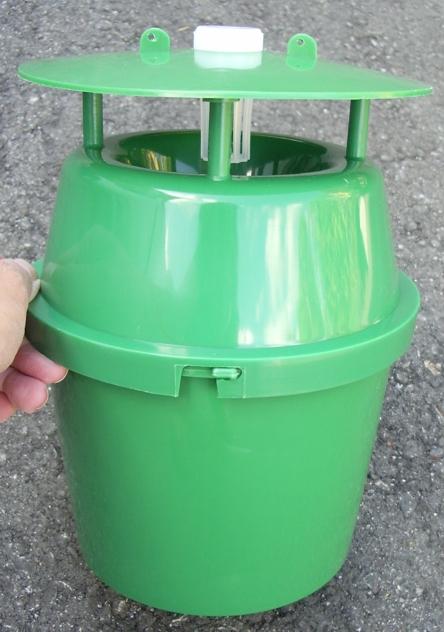
Figure 2. Green unitraps mounted singly on posts at the edge of a field are used for pheromone trap monitoring of male clover casebearer moths.
In the span of one week some traps can catch over 1000 casebearers! The casebearers are retrieved then later counted by summer students (Fig. 3) who wear gloves and dust masks to protect against the insecticidal vapona strip and inhalation of the tiny scales of the moths which coat the inside of the traps like dust.
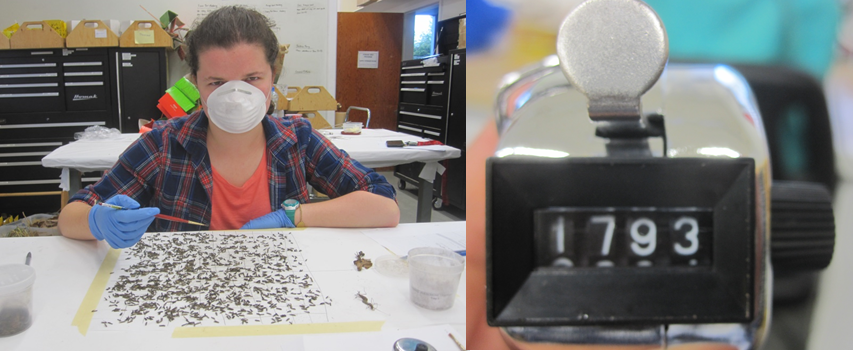
Figure 3. Summer students count and record the number of casebearers collected from each pheromone trap. This trap had 1793 casebearer moths.
For more information on red clover casebearers in the Peace River region, visit http://www1.agric.gov.ab.ca/$department/deptdocs.nsf/all/prm4587
Tuesday, 9 August 2016
This Week in the Lab - Prairie Pest Monitoring
Throughout this summer, the IPM lab at the Beaverlodge Research Farm performs weekly monitoring to support the Prairie Pest Monitoring Network (PPMN). On a weekly basis, Staff perform outings to collect and deploy insect traps at canola fields in the area to help obtain data to represent the region. Target insects include flea beetles, diamondback moths, swede midge, red clover casebearers, bertha armyworm, wheat midge, grasshoppers, and lygus bugs (protocols and descriptions for each insect pest can be accessed at http://insectpestmanagement.blogspot.ca/p/blog-page.html).
These insects, by way of their feeding on leaves, buds, flowers, stems, and seeds cause economic levels of damage either by reducing quality or yield when outbreak populations are not detected or managed at the proper time. Thus, the weekly PPMN outings were necessary to monitor and assess arthropod species and densities throughout the growing season at various fields in the Peace River region. Monitoring species diversity and densities helps us understand the biology of these organisms and provides insight into interactions between the host plants they affect and even some of the natural enemies that help regulate their densities in field crop situations.
In canola, sticky card and pheromone traps were deployed mid-May at commercial fields of canola just after they were seeded. Monitoring continued weekly until traps were retrieved early in August as the seeds within canola pods were beginning to change colour. On August 2nd, all of the traps at the two sites situated in the BC-side of the Peace River region were taken down. On August 9th, all the traps at the seven sites in the Alberta-side of the Peace River region were taken down. The last picture shown below is from Wilson’s canola field (site id: 2016-005) on August 9th, 2016, when the mean canola growth rating stage was a 5.2 (Harper and Berkenkamp 1975).
 |
| Figure 1. Development of the canola at Site ID#2016-005 from May to August of 2016 (Upper L to Lower R) from seeding, cotyledon, rosette, flowering, and pod stages. Photo credits: Celine, Jadin, Emily and Kaitlin. |
The past three months in the IPM lab have represented a roller coaster of experiences. As the final weeks zoom by, I’d like to thank everyone at BRF for being so amazing, helpful, and for being a part of this journey. Here’s to mosquito bites and canola - Cheers everyone and wishing you all the best! :)
- Celine
Sunday, 7 August 2016
2016 Peace Canola Survey - Summary is available now!
The 2016 Annual Peace Canola Survey was completed by Agriculture & Agri-Food Canada staff based at Beaverlodge and Saskatoon.
Since 2003, the annual survey has been performed with the main objectives of (i) collecting insect pest data throughout the region and (ii) to detect the introduction of the cabbage seedpod weevil into the Peace River region. In 2016, a total of 156 commercial fields of Brassica napus (e.g., each field ≥80 acres in size) were surveyed and no B. rapa was encountered.
Fields were surveyed by sweep-net using 50 - 180° sweeps on the following dates in these areas:
• July 5 near Whitelaw, Berwyn, Grimshaw, Dixonville, Manning, Hotchkiss, Hawk Hills, Notikewin, Blue Hills, Buffalo Head, La Crete.
• July 6 near Fort Vermilion, Blumenort, Valhalla, La Glace, Westmark, Woking, Spirit River, Blueberry Mountain, Silver Valley, Bonanza, Bay Tree, Beaverlodge, Halcourt, Wembley, Grande Prairie, Clairmont, Sexsmith, Teepee Creek, Bezanson, Dimsdale, Huallen, Fairview, Vanrena, Hines, Creek, Worsley, Eureka River,
• July 7 near Rycroft, Webster, Hythe, Wanham, Girouxville, Watino, Eaglesham, Belloy, Dawson Creek, Rolla, Dow River, Clayhurst, Cecil Lake, Fort St. John, Farmington, Valleyview, Guy, Falher, Reno, Nampa, Peace River, Marie-Reine, McLennan, Whitemud Creek.
Sweep-net samples were frozen then processed to generate data for a total of 21,278 arthropods which were identified and categorized into 38 taxa. The 2016 summary includes 15 economically important pests of canola reported from 156 surveyed canola fields plus data related to rotational practises in the Peace River region.
The 2016 summary is available as a downloadable PDF file.
THANK YOU to the following hard working AAFC staff who surveyed†, processed‡, and mapped∞ this data: Jadin Chahade1†‡, Kaitlin Freeman1†‡, Holly Spence1†‡, Hannah Avenant1†‡, Laura Stewart1†‡, Celine Coschizza1†‡, Emily Lemke1†‡, Owen Olfert2†∞, Taylor Kaye2†∞, Shelby Dufton1‡, and Amanda Jorgensen1‡.
Finally, and MOST IMPORTANTLY, Thank you to our canola producers for allowing us to sample in their fields!
Since 2003, the annual survey has been performed with the main objectives of (i) collecting insect pest data throughout the region and (ii) to detect the introduction of the cabbage seedpod weevil into the Peace River region. In 2016, a total of 156 commercial fields of Brassica napus (e.g., each field ≥80 acres in size) were surveyed and no B. rapa was encountered.
Fields were surveyed by sweep-net using 50 - 180° sweeps on the following dates in these areas:
• July 5 near Whitelaw, Berwyn, Grimshaw, Dixonville, Manning, Hotchkiss, Hawk Hills, Notikewin, Blue Hills, Buffalo Head, La Crete.
• July 6 near Fort Vermilion, Blumenort, Valhalla, La Glace, Westmark, Woking, Spirit River, Blueberry Mountain, Silver Valley, Bonanza, Bay Tree, Beaverlodge, Halcourt, Wembley, Grande Prairie, Clairmont, Sexsmith, Teepee Creek, Bezanson, Dimsdale, Huallen, Fairview, Vanrena, Hines, Creek, Worsley, Eureka River,
• July 7 near Rycroft, Webster, Hythe, Wanham, Girouxville, Watino, Eaglesham, Belloy, Dawson Creek, Rolla, Dow River, Clayhurst, Cecil Lake, Fort St. John, Farmington, Valleyview, Guy, Falher, Reno, Nampa, Peace River, Marie-Reine, McLennan, Whitemud Creek.
Sweep-net samples were frozen then processed to generate data for a total of 21,278 arthropods which were identified and categorized into 38 taxa. The 2016 summary includes 15 economically important pests of canola reported from 156 surveyed canola fields plus data related to rotational practises in the Peace River region.
The 2016 summary is available as a downloadable PDF file.
THANK YOU to the following hard working AAFC staff who surveyed†, processed‡, and mapped∞ this data: Jadin Chahade1†‡, Kaitlin Freeman1†‡, Holly Spence1†‡, Hannah Avenant1†‡, Laura Stewart1†‡, Celine Coschizza1†‡, Emily Lemke1†‡, Owen Olfert2†∞, Taylor Kaye2†∞, Shelby Dufton1‡, and Amanda Jorgensen1‡.
Finally, and MOST IMPORTANTLY, Thank you to our canola producers for allowing us to sample in their fields!
Friday, 22 July 2016
So far in our monitoring.....
What we're seeing so far in our field monitoring.....
From what I’ve seen so far, I would have expected a bit of grasshopper
spraying by now and the next 10 days of heat and sun may bring about some
spraying for Lygus but most canola will be at the pod stage by then and surely with
the heat. Overall, there are some very nice crops are out there despite
some water damage. Apart from cutworms, it hasn’t been a big insect pest
outbreak year so far in the Peace.
We finished our Annual Canola
Survey of the Peace on July 8th but we are processing the samples
from the 156 sites. Please watch our IPM Lab Blog
though – I will post our survey results there first.
Earlier this spring, there were
cutworms and fields in the Peace were sprayed to try and manage that – I have
no idea the number of acres though. To date, our monitoring has shown low
DBM and BAW pheromone count interceptions. Wheat midge was forecasted to
be lower populations through most of the entire Peace this season, however,
midge flight synchronized fairly well with wheat anthesis in the south
Peace. We have seen some higher lygus bug numbers in some of our canola
survey samples but the persistent rain throughout June-present has been a major
factor in all our field crops. More specifically, we aren’t seeing the
typical nymph densities that we’d expect in the canola so far (because we know
many have died owing to rain falling every 4-6 days from bolting through to
early flowering) – stay tuned for the survey results though. Grasshoppers
are present but the situation is nowhere near the high risk originally
forecasted back in January for the Peace.
Almost all the fields we’ve seen
around the south and north Peace have received some fungicide whether it’s been
wheat, peas, or canola. As Jim notes, producers are sometimes keen to
tank-mix insecticide with the fungicide application and only the agricultural
industry people will know those statistics on what product has been sold so far
this season.
Monday, 18 July 2016
Rearing parasitoids that attack Lygus
As mid-June approaches, Lygus in the Peace Region will be starting to lay their eggs into the stems and leaves of canola, alfalfa, and other plants. Later in the summer, when then the canola and other crops are more developed, adults and nymphs (Fig. 1) can damage crop yields when they feed on the juicy plant material of these crops. They pierce through the plant tissues with their sucking mouthparts- which often leave visible lesions on stems, buds, flowers and pod surfaces. Buds and flowers drop as a result and the seed pods often turn brown and shriveled from being fed on. The economic damage on canola in the Peace region is all caused by Lygus species native to North America.
 |
| Figure 1. Lygus nymph on the left and adult Lygus on the right (image retrieved from http://www1.agric.gov.ab.ca/$department/deptdocs.nsf/all/agdex741). |
Lygus can be pale green to reddish-brown to black and have a distinct V-shape centered on their dorsal side (Fig. 1). Lygus overwinter as adults. Theyemerge early in spring. Canola is most susceptible to damage from Lygus at late flowering through the early pod stages.
The phenology of Lygus varies by region with 2-3 generations per year in the south of the Canadian prairies to only one generation per year in the Peace River region. Lygus feeding damage will depend upon growing conditions. Abundant rainfall helps canola compensate, whereas hot, dry growing conditions favour Lygus development and often result in high populations capable of causing damage and yield losses. If canola fields are adjacent to hay fields, early season monitoring of Lygus densities within the alfalfa can often help growers anticipate Lygus in bolting and early flowering canola.
The economic threshold for Lygus in canola varies by canola crop stage and is applied at late flower or early pod (Table). It depends on sweep-net monitoring at multiple sites within a field and counting both adults and nymphs (3rd-5th instar stages). When densities exceed the economic threshold is exceeded registered foliar-applied insecticides are used to reduce feeding damage and protect the developing pods and seeds which then results in quality and yield being maintained. There are a number of natural enemies that help reduce and regulate Lygus populations; notable wasp parasitoids include species from the Family Mymaridae and Braconidae. In North America, the braconid, Peristenus pallipes has been reared from Lygus lineolaris and L. keltonii as well as L. shulli. A potential biological control agent also worth mentioning is Peristenus digoneutis which is a parasitic wasp or European origin that can attacks nymphal stages of Lygus rugulipennis Poppius but has shown a degree of host preference for North American species of Lygus and has been released to in eastern Canada in strawberry production systems. Historically, Peristenus digoneutis was released on the Canadian Prairies in the 1970’s but failed to establish in detectable numbers. Efforts still continue to investigate P. digoneutis as a biocontrol agent for Lygus found in canola grown in Canada.
 |
| Figure 2. Peristenus digoneutis here is shown laying an egg in a lygus nymph (image retrieved from: http://www.biocontrol.entomology.cornell.edu/parasitoids/peristenus.php ). |
In our lab, we have prepared Peristenus rearing cages and mass collections were performed during the last week of June. Mass collection involves sweeping the canopy then retrieving live specimens back for processing. The density of Lygus is recorded and nymphs are isolated for rearing.
Peristenus wasps attack and lay an egg within 1st-2nd instar stages of Lygus nymphs (Fig. 2). Once the egg hatches, the Peristenus larva develops within the body of a Lygus nymph so we rear the nymphs until they either mature to adults or a Peristenus larva emerges from the host to then drop down to the soil and spin its cocoon (Fig. 3). We monitor the number of Peristenus cocoons that arise from the Lygus nymphs then the cocoons will be transferred to collaborators at AAFC-Lethbridge who will continue to rear and obtain the live wasps the following spring.
 |
| Figure 3. Peristenus rearing cages at Beaverlodge Research Farm. |
Sources:
Haye, T., et al. "Controlling Lygus Plant Bugs (Heteroptera: Miridae) with European Peristenus relictus (Hymenoptera: Braconidae) in Canada – Risky Or Not?" Bulletin of Entomological Research 96.2 (2006): 187-96.
Friday, 17 June 2016
Wheat midge pheromone trapping
This week at the farm: wheat midge monitoring
Our wheat midge monitoring will be getting into full swing very quickly. Make sure to check out the 2016 Wheat midge forecast map and read the protocol on wheat midge.
This week we have a short comic to help you better understand wheat midge pheromone trapping and what we can do with this tool. In the coming weeks look forward to learning why this pest is so important to monitor.
 |
| Page 1 (click to enlarge) |
 |
| Page 2 (click to enlarge) |
Thursday, 16 June 2016
2016 Natural Enemies Project
There has been much going on so far this summer with our
Wheat Midge Natural Enemies Project. So
far, we have seeded our plot
trial and have been collecting samples from the plots using a method
called pitfall trapping. This is similar
to what Hannah described here
for the pea leaf weevil but these traps do not use a lure. The pitfall traps
used for this study are comprised of two containers and a funnel made out of
the top portion of a 2-Liter pop bottle.
As they are walking along the soil surface, arthropods fall into the funnel and
slide down into the trap, which contains a mixture of antifreeze and
water. This solution kills and preserves
them until we collect them each week.


Figure 1. (A) The
pitfall trap sits flush with soil in the middle a row in each plot. (B) The
pitfall sample after the inner container has been removed. Specimens are preserved in antifreeze
solution which is the pink liquid that can be seen in the photo.
The pitfall traps collect a variety of arthropods which includes a fascinating array of beetle species.
The beetles we collect come in all shapes and vary from 2 mm to 4 cm in
length. Some of the most exciting of
these are the beetle predators which are one of the main focuses of this study. The goal of this project is to provide a
unique comparison of beetle diversity and the rotation practices utilized by
growers in the Peace River region.

Figure 2. The biodiversity of beetles collected in wheat
can be seen in this sample from the 2015 pitfall trap collections.
Ground Beetles
Carabidae, commonly known as ground beetles, is the largest
family in the suborder, Adephaga, which comes from the Greek adephagos or ‘gluttonous.’ Gluttonous goes a long way in describing this
family, as ground beetles are voracious feeders and often are cited as important
predators. Ground beetles are known to
feed on aphids, cabbage root flies, Lepidopteran larvae, and many other pest
species. Carabid beetles make up the
vast majority of the beetles we pick up in our pitfall traps. Keep an eye out for them in the field; they
have long slender legs made for running and vary in color. Dark coloration generally denotes nocturnal
species and metallic coloration usually indicates species that are active
during the day.

Tiger Beetles
Though they may look quite different, tiger beetles are a
sub-order in the Carabidae family. Tiger
beetles have long, sickle shaped mandibles (mouthparts made for chewing) and
bulging eyes. The larval stage of these
beetles is known to create tunnels in the soil substrate. There, they lie in wait to ambush prey at the
opening of the tunnel. When their prey
walks by, the larva grabs it and drags it down to the bottom of the tunnel to
feed. The adults of these species are
rapid fliers and have distinctly long legs that allow them to run quickly over
the soil surface.

Rove Beetles
Staphylinidae, or rove beetles, are another important family
in terms of predation. Rove beetles
typically have shortened elytra that do not completely cover their abdomen. Elytra are the hardened forewings that characterize
all beetles. Having shortened elytra
allows rove beetles to maneuver more readily in the field. However, there is a trade off - shortened
elytra expose them to a greater risk of desiccation which makes them dependent
on humid habitats. Rove beetles are
great predators and can even be parasitic.
Check out this link
to see one of the parasitic rove beetles (Aleochara
spp.) that emerged from a cabbage root fly pupa that we collected in October
2015.

-Shelby
Monday, 6 June 2016
Bertha armyworm monitoring
This week on the Farm: Bertha Armyworm (Mamestra configurata)
The past few days we have been very busy setting up Bertha Army Worm traps. Bertha Armyworm adults will begin to emerge from their overwintering pupa around early June and will continue until early August. The number of adults collected by a trap will provide an indication of the risk of larval damage.
When setting up a monitoring site for Bertha Armyworm, it is important that the traps are not placed next to a shelterbelt, ditch, or within ½ a kilometer of a strong light source. Each trap should be located about 2 m from the edge of the field. In the Peace River region, previous trapping has resulted in high numbers of native Bombus species so only one trap is deployed per site.
The traps used to monitor Bertha Armyworm are called Unitraps. The trap is all green and is mounted approximately 1metre above the ground on a strong stake (Figure 1). Inside the trap, a pheromone lure is positioned to attracts male moths into the bucket then a Vapona insecticide strip within the bottom of the trap kills the males once they are inside the bucket.
Our Bertha armyworm traps are collected weekly. To do so, the Unitrap is opened, the contents are carefully emptied into a small brown paper bag which is labelled then stapled shut. The sample is taken back to the lab where the moths and by-catch are sorted and typically the specimens are pinned and labelled.
Presently, non-automated traps are used. However, because Bertha Armyworm moths are active at dusk, our lab has tested automated pheromone traps that remain closed during the day to reduce by-catch of Bombus species. That automated traps were designed to remain closed during the day but automatically open in the evening to attract and intercept bertha armyworm males during peak flight times.
For more information on Bertha Armyworms follow the link to the protocol: http://www.westernforum.org/Documents/IPMN%20Protocols/2013_BAW%20Monitoring%20protocol.pdf
-Kaitlin
The past few days we have been very busy setting up Bertha Army Worm traps. Bertha Armyworm adults will begin to emerge from their overwintering pupa around early June and will continue until early August. The number of adults collected by a trap will provide an indication of the risk of larval damage.
When setting up a monitoring site for Bertha Armyworm, it is important that the traps are not placed next to a shelterbelt, ditch, or within ½ a kilometer of a strong light source. Each trap should be located about 2 m from the edge of the field. In the Peace River region, previous trapping has resulted in high numbers of native Bombus species so only one trap is deployed per site.
The traps used to monitor Bertha Armyworm are called Unitraps. The trap is all green and is mounted approximately 1metre above the ground on a strong stake (Figure 1). Inside the trap, a pheromone lure is positioned to attracts male moths into the bucket then a Vapona insecticide strip within the bottom of the trap kills the males once they are inside the bucket.
 |
| Figure 1. Unitrap mounted on stake within a field (photo source: http://insectpestmanagement.blogspot.ca/p/blog-page.html) |
Our Bertha armyworm traps are collected weekly. To do so, the Unitrap is opened, the contents are carefully emptied into a small brown paper bag which is labelled then stapled shut. The sample is taken back to the lab where the moths and by-catch are sorted and typically the specimens are pinned and labelled.
Presently, non-automated traps are used. However, because Bertha Armyworm moths are active at dusk, our lab has tested automated pheromone traps that remain closed during the day to reduce by-catch of Bombus species. That automated traps were designed to remain closed during the day but automatically open in the evening to attract and intercept bertha armyworm males during peak flight times.
For more information on Bertha Armyworms follow the link to the protocol: http://www.westernforum.org/Documents/IPMN%20Protocols/2013_BAW%20Monitoring%20protocol.pdf
-Kaitlin
Monday, 30 May 2016
Diamondback moth monitoring
The host plants of the diamondback moth (Figure 1) belong to the family Brassicaceae, which includes canola, mustard, and broccoli. They lay their eggs on these plants, and these hatch to be small miners, which live inside the leaves. Older larvae are yellow-green caterpillars, which eat the leaves, flowers, and other tissues of the plant. The larvae finally pupate in cocoons on these plants and emerge as moths. Each year, Diamondback moths travel north into Canada using high altitude air masses. Moths travel from Mexico, southern United States and the Pacific northwest from April and on through the growing season.
The IPM team monitors diamondback moths throughout the Peace River region with the goal of determining the timing and magnitude of the moths’ mass migration. To do this, we set up delta traps (Figure 2). These traps are lined with sticky cards and baited with the alluring scent of female pheromones to attract male diamondback moths. We align the traps east-west to funnel the prevailing winds. The traps are generally set out in late April and the sticky cards are collected weekly for 6 weeks or longer, depending on the timing of the moths’ arrival. Later in the season, once the crops have grown, we also count the number of diamondback larvae present on the plants per unit area by doing a beat sample. For more information about the life cycle and monitoring of the diamondback moth, check out our monitoring protocols.
Back at the lab, we count the number of moths on each card (Figure 3). Working with the cards can be challenging, as the sticky substance will cover the lab tables, the instruments, and students’ fingers if these items are not protected. We also record the results of the beat sample and amalgamate all the data. The location of the site and the timing of each collection, along with the economic threshold for each crop, provide information about when crops should be sprayed with pesticides.
- Laura
 |
| Figure 1. Diamondback moth adult, larva and pupa (Wikimedia Commons, Government of Manitoba). Note the two prolegs at the rear of the larva that form characteristic "spurs". |
The IPM team monitors diamondback moths throughout the Peace River region with the goal of determining the timing and magnitude of the moths’ mass migration. To do this, we set up delta traps (Figure 2). These traps are lined with sticky cards and baited with the alluring scent of female pheromones to attract male diamondback moths. We align the traps east-west to funnel the prevailing winds. The traps are generally set out in late April and the sticky cards are collected weekly for 6 weeks or longer, depending on the timing of the moths’ arrival. Later in the season, once the crops have grown, we also count the number of diamondback larvae present on the plants per unit area by doing a beat sample. For more information about the life cycle and monitoring of the diamondback moth, check out our monitoring protocols.
 |
| Figure 2. Delta trap used to capture diamondback moth moths in situ. The pheromone lure is hung inside the trap and moths are collected on the sticky card inserted on the inner surface of the trap. |
Back at the lab, we count the number of moths on each card (Figure 3). Working with the cards can be challenging, as the sticky substance will cover the lab tables, the instruments, and students’ fingers if these items are not protected. We also record the results of the beat sample and amalgamate all the data. The location of the site and the timing of each collection, along with the economic threshold for each crop, provide information about when crops should be sprayed with pesticides.
 |
| Figure 3. Sticky card with diamondback moths marked using a blue dot. By-catch insects include flies and beetles. |
Saturday, 28 May 2016
Pea Leaf Weevil Monitoring
The pea leaf weevil (Sitona lineatus) is an insect pest native to Europe but established in Alberta in 2005 and southwest Saskatchewan in 2007. Host plants include peas and faba beans and pea leaf weevils can cause considerable damage and yield loss in these crops. Losses result from the larval stage feeding on plant roots and the reduction of nitrogen fixation by preferential feeding on root nodules. Losses can also result from adults feeding upon leaves which is characterized by scalloped notches along the edge of pea leaves.
Pea leaf weevil overwinter as adults which become active early in spring. The adults move from overwintering habitats to legume host plants to feed, generally from late May through to early June. During this time, pea leaf weevil populations are best estimated by plant damage assessments. More details on pea leaf weevils and monitoring protocols can be found here.
Pheromone-baited pitfall traps are used to detect and monitor pea leaf weevil. Pitfall traps intercept arthropods at ground level. Each trap consists of a plastic container (500 mL) that is submerged in the soil so the opening sits at ground level (Figure 1). Each trap is baited with an aggregation pheromone lure then ~175 mL of a solution of RV antifreeze and water (ratio of 1:1) is poured into the base of the pitfall trap. The solution both kills and preserves the arthropods that are attracted and fall into the trap (see Figure 1). The pheromone, developed by the University of Alberta, is suspended from the wire mesh and attracts the pea leaf weevils (see Figure 2). The pitfall trap is then covered with wire mesh to exclude field trash and small vertebrates. All arthropods are collected weekly from traps then preserved in 95% ethanol for later identification. Back in the lab, the arthropods are processed by selecting out weevils, ground and rove beetles which are pinned or pointed to enable identification.
The monitoring of pea leaf weevils is important since its distribution has recently changed to include a more northerly range. Pea leaf weevil was initially discovered in Alberta near Lethbridge in 2005. Since then, its distribution increased to include southern Alberta to just north of Edmonton and east into southwestern Saskatchewan. In 2015, pea leaf weevil damage on faba bean was observed in central Alberta and helped confirm an increase in range compared to its previous limit. The 2015 risk map for pea leaf weevil is available here. More information on the impact of pea leaf weevils feeding on faba beans can be found here.
- Hannah
Pea leaf weevil overwinter as adults which become active early in spring. The adults move from overwintering habitats to legume host plants to feed, generally from late May through to early June. During this time, pea leaf weevil populations are best estimated by plant damage assessments. More details on pea leaf weevils and monitoring protocols can be found here.
 |
| Figure 1. Pitfall trap containing RV antifreeze solution and covered with wire mesh. |
Pheromone-baited pitfall traps are used to detect and monitor pea leaf weevil. Pitfall traps intercept arthropods at ground level. Each trap consists of a plastic container (500 mL) that is submerged in the soil so the opening sits at ground level (Figure 1). Each trap is baited with an aggregation pheromone lure then ~175 mL of a solution of RV antifreeze and water (ratio of 1:1) is poured into the base of the pitfall trap. The solution both kills and preserves the arthropods that are attracted and fall into the trap (see Figure 1). The pheromone, developed by the University of Alberta, is suspended from the wire mesh and attracts the pea leaf weevils (see Figure 2). The pitfall trap is then covered with wire mesh to exclude field trash and small vertebrates. All arthropods are collected weekly from traps then preserved in 95% ethanol for later identification. Back in the lab, the arthropods are processed by selecting out weevils, ground and rove beetles which are pinned or pointed to enable identification.
 |
| Figure 2. Pheromone suspended from wire mesh using green twist tie. |
The monitoring of pea leaf weevils is important since its distribution has recently changed to include a more northerly range. Pea leaf weevil was initially discovered in Alberta near Lethbridge in 2005. Since then, its distribution increased to include southern Alberta to just north of Edmonton and east into southwestern Saskatchewan. In 2015, pea leaf weevil damage on faba bean was observed in central Alberta and helped confirm an increase in range compared to its previous limit. The 2015 risk map for pea leaf weevil is available here. More information on the impact of pea leaf weevils feeding on faba beans can be found here.
- Hannah
Wednesday, 25 May 2016
Canola Scouting Chart for Insect Pests
The canola insect pest scouting chart is available to help support your in-field scouting.
The chart was first offered in 2015 but we again post it to aid in-field scouting on the Canadian prairies. Two versions are accessible on the Prairie Pest Monitoring Network's Blog – the first version contains hyperlinks to help growers learn more about some of our insect pests and how to monitor while the second version may be easier to view or print.
2016 Prairie Pest Monitoring Network's WEEKLY UPDATES
Weekly Updates are now available as downloadable PDF files on the Prairie Pest Monitoring Network's Blog.
You can also access the Weekly Update as a series of Posts on that Blog's homepage.
You can also access the Weekly Update as a series of Posts on that Blog's homepage.
Friday, 20 May 2016
2016 Staff at Beaverlodge!
This spring we again welcome students to the Farm. These young people are learning about agriculture and gaining experience in our labs while accomplishing important tasks that allow our research to progress. We're pleased that so many have come from so far!
Meet the IPM Program's new staff members and see what Hannah, Celine, Emily, Laura, Kaitlin, Jadin, Shelby, and Amanda are busy doing!
Meet the IPM Program's new staff members and see what Hannah, Celine, Emily, Laura, Kaitlin, Jadin, Shelby, and Amanda are busy doing!
Subscribe to:
Posts (Atom)