Tuesday, 27 June 2023

20 Years of Canola Surveying

This year will be our lab’s 20th annual canola survey! It will be my 10th canola survey – helping out from start to finish.  As you may have seen, our survey will be a little different this year. We are now required to obtain written permission prior to entering any fields. If you are a producer in the Peace River region, then hopefully we have already chatted on the phone with you! If not, you can contact us so that we can sample your fields!

Historically, we have sampled fields randomly, stopping at a canola field in early flower every 10 km along pre-designated routes. This provided us with a truly random, representative sample of insect populations in the Peace River region. Randomly sampling is very important to the accuracy and quality of information gathered during the survey. We are hoping to have enough fields in the system this year that we can select “randomly” from fields we have on file.

Figure 1. Amanda Jorgensen sweep sampling a canola field (2014). Photo credit: Kate Freeman-AAFC Beaverlodge.

Our lab has been very fortunate to have received a great reception for our canola survey! In the 10 years I have worked on the survey, I am one of the only staff members to encounter a producer who was concerned to see us in their field. Many years ago, a producer pulled up as we finished sweeping, which isn’t unusual. What was unusual was their concern at finding a blue van parked in their pull-in. After my teammate and I explained a bit about the survey and showed the insects in our net, we ended up having a positive conversation! It turned out that teenagers had been causing havoc out in their fields the night before, so their initial concern was completely understandable! It was a great learning experience for me, and I feel fortunate that we had the chance to build a good relationship with this producer. Our lab has worked hard to develop strong relationships with field crop producers in our area – and we hope that if we haven’t worked with you yet, we can work together soon!

Author: Amanda Jorgensen


Thursday, 22 June 2023

20 Years of Canola Surveying

I would say one of my favorite canola survey memories was my first survey in 2021 with our supervisor and integrated pest management scientist, Jennifer Otani. We saw an incredible amount of grasshoppers in certain areas throughout the Peace River region, often in numbers above the economic threshold (Fig. 1)! In some locations, there were so many that the ditch looked like it was moving when we swept it - I have never seen anything like it! This is the first time I was able to see what grasshopper feeding looked like in canola. They are super messy eaters! While we were surveying, Jennifer pointed out butterflies sipping salt from mud puddles, which I never knew they did! It was quite the sight about 10 butterflies all still on the earth. I remember coming home that day (at 10:00pm), excited at having learned so many things about surveying and insect monitoring. Jennifer is an great person to learn from. That was my longest work day to date and one of my favorites. The next day I had trouble moving my arms because they were so sore from all of the sweeping, but I would do it all over again (and did for the rest of the week)!

Figure 1. Grasshoppers cover the inside of a sweep-net after collecting a sample during the annual canola survey.


I was so excited to go to work every day during the canola survey! I enjoyed collecting sweep-net samples, moving at a fast pace, and covering a huge geographic area - it’s exhilarating (Fig. 2)! We try to cover as much of the agricultural land in the Peace River region as possible– sometimes working up to 12 hours in a single day (Fig. 3)!

Figure 2. Aarika walking back to the vehicle after collecting a sweep-net sample for the 2021 Canola Survey.

I always look forward to the results of the survey because it covers a larger area than our weekly surveying. If we observe anything unusual, this data is shared publicly with producers so that they are able to make informed decisions when managing their canola. Working at the research farm, I have gained an appreciation for the importance of surveying as it provides invaluable data over many years. The canola survey is a great example of this, representing 20 years of data for an important crop in our region. It takes a village to be able to execute such a big endeavor.


Figure 3. Sweeping in action in Fort Vermillion, AB! We kept busy this day, doing both alfalfa fields as well as canola survey sites to make the most of our 6 hour drive up.

Each field is its own adventure and it is always interesting to see what insects and staging you find in fields a few or a hundred kilometers apart. There is so much biodiversity in our region from the BC Peace to Fort Vermillion to Peace River. The final bonus of surveying: you get to stop in small towns and try the local food while sitting outside in the sun. It truly makes for a great day. I never get tired of seeing the beauty of different regions of the Peace River region  and spending time with great coworkers, doing a job I love!

Author: Aarika Harpe


Tuesday, 20 June 2023

2023 Canola Survey: Lygus

As we draw closer to the end of June, lygus bugs (Fig. 1) will be emerging and laying eggs in the Peace River region. Canola is especially susceptible to lygus damage, in addition to alfalfa, potatoes, and other plants. Typically, lygus migrate from alfalfa to canola when buds and flowers are developing in June through early July. Crops can be severely damaged by the feeding of adult and nymph lygus, resulting in loss of yield and a decrease in quality.

In the Peace River region, adult lygus lay eggs during mid-June in the stems and leaves of plants. Egg laying occurs over three to seven weeks.

Figure 1: Fifth instar lygus nymph (left) and adult lygus (right). Photo credit: Jennifer Otani-AAFC Beaverlodge

Early instar lygus nymphs are light green and wingless. As they mature, black dots develop on the top of the thorax and abdomen and wing buds begin to develop (Fig. 3). Adult lygus range from pale green to reddish brown and have a distinctive triangle or “V’ shape marking on their back (Fig. 2). Both adult and nymph lygus bugs have piercing-sucking mouthparts that physically damage plants.


Figure 2: Adult lygus. Photo credit: Jennifer Otani-AAFC Beaverlodge.

Figure 3: Fifth instar lygus nymph. Photo credit: Jennifer Otani-AAFC Beaverlodge.

When feeding, these mouthparts pierce seedpods and puncture plant cells, leaving visible abrasions on plant surfaces. Lygus insects also inject toxic saliva while feeding, that perniciously effect host plants. Feeding damage collectively results in leaf disfiguration, drooping of buds and blossoms, and shriveling of seeds.

Hot, dry conditions encourage lygus development and population growth. The economic threshold for lygus in canola encompasses the flowering and early pod ripening stages. Economic thresholds and plant stage should be carefully considered when choosing to apply insecticide. Application costs may exceed resulting benefits if seeds have already ripened to yellow or brown. Information about economic thresholds and lygus monitoring can be found here. 

Author: Jadeyn Lunn

Thursday, 15 June 2023

20 Years of Canola Surveying

Our annual canola survey is my favourite part of the summer! As a life-long resident of Alberta, I love visiting fields across the Peace River region, especially areas in Alberta and British Columbia that I would not regularly go. As someone who loves to spend time outdoors during the summer, I really enjoy the long canola survey days spent sweeping the Peace. You will sometimes see us out surveying as late as 10 PM and making the most of the extra daylight hours we get in the summer!

Figure 1. Maddy sweeping a canola field near Deadwood, AB during the 2022 Canola Survey. Photo credit: Shelby Dufton-AAFC Beaverlodge.

During the survey, we travel across the entire Peace River region which is an enormous area! Our survey covers 260 km from east to west and 400 km north to south. Last year during our annual canola survey, I travelled 5 hours north to High Level which is the furthest north in Alberta that I have ever been. On this trip, I was able to take the La Crete ferry which was one of my favourite days of canola survey. We use the La Crete ferry as well as the Shaftesbury ferry to access some of the more remote canola fields in the Peace River region.


Figure 2. Crossing the Peace River at Tomkins Landing on the La Crete ferry after surveying in La Crete and Fort Vermillion, AB. Photo Credit: Madysen Jones-AAFC Beaverlodge.

Our annual canola survey is an excellent learning experience for students. It provides valuable information on pest insect populations1, 2, species diversity, and beneficial insects throughout the region. This year, I am looking forward to another successful canola survey with the help of the generous farmers that have agreed to allow us to enter their fields. If you would like to be a part of our survey more information can be found here!

Author: Madysen Jones

Tuesday, 13 June 2023

2023 Canola Survey: Cabbage Seedpod Weevil

Cabbage seedpod weevils (Ceutorhynchus obstrictus) are small, grey beetles from the family Curculionidae, which are 3 to 4 mm long with a long curved snout or rostrum (Fig. 1). Their larva are small, white grubs that can reach 5 to 6 mm long. Adults emerge in the spring from overwintering sites such as ditches and shelter belts and feed on early flowering host plants including volunteer canola and wild mustard. Cabbage seedpod weevils move to canola fields when the crop starts to bud and flower, where they feed on pollen and buds from the canola plants.

Egg-laying occurs when canola pods begin to develop. Female cabbage seedpod weevils typically deposit a single egg into a seedpod, but can lay two or more per pod during outbreaks. Upon hatching, larvae begin to feed on the seeds for a period of about 50 days. Once they mature, larvae chew an opening in the wall of the seedpod and exit, pupating in the soil below. After about ten days as pupae, adults emerge and feed on the maturing canola seedpods before moving to overwintering sites.

Severe damage to canola crops can occur as a result of both the larva and adults feeding on seedpods. Larval feeding on seeds can cause misshapen pods and leave small exit holes when the larva emerge to pupate. The economic threshold at which pesticide application is recommended is 2.5 to 4 weevils per sweep.

Figure 1. Cabbage seedpod weevil adult. Photo credit: linsepatron CC-BY 2.0.

While not currently present in the Peace River region, cabbage seedpod weevils are a major pest in southern Alberta. Models predict that they will gradually disperse into all canola production areas, including the Peace River region. The Beaverlodge Integrated Pest Management program monitors for presence of cabbage seedpod weevils in the Peace River Region by performing our annual canola survey. Sweep-net collections are performed at canola fields throughout the region when 10-20% of plants are flowering.

To help us complete our canola survey this year, we need permission to enter canola fields across the Peace River region. You can help us monitor for pests like the cabbage seedpod weevil here!

Author: Gareth Larsen


Friday, 12 May 2023

Meet Our 2023 Staff!

*Updated 05June2023* Help us welcome our newest student, Jadeyn!

Amanda Jorgensen - IPM Technician

I am one of the two technicians working in the Insect Pest Management (IPM) lab at AAFC-Beaverlodge. My name is Amanda Jorgensen, and I have 10 years of experience working in our lab now. You can read my previous posts here: 2019, 2017, and 2016. I have completed a B.Sc. in Biology and Environmental Sciences, and a M.Sc. comparing the effectiveness of different monitoring tools for detecting and estimating wheat midge populations in the Peace River region. If you want you can read more about my work on wheat midge monitoring or seasonal wheat midge emergence. For the last five years, I have been responsible for a number of projects in forage seed production (clover, alfalfa, creeping red fescue, timothy grass, etc.).

Figure 1. Amanda Jorgensen releasing R. pilosa (a weed biocontrol agent) in a patch of common yellow toadflax (Photo: AAFC-Dufton 2022).

These projects have had strong biodiversity components and have examined the seasonal patterns, population density, and distribution of both pest and beneficial insect species. We have also been monitoring for and tracking the introduction of invasive species in our area – including red clover casebearer moth, European skipper, cereal leaf beetle, and pea leaf weevil, as well as invasive species that aren’t here yet – like Japanese beetle and Agriotes wireworms.

Figure 2. A red clover casebearer moth larva standing on a red clover flowerhead (Photo: AAFC-Jorgensen 2020).

We still need to conduct statistical analyses on the data we collected over the last few years, but biodiversity as well as numbers of beneficial insects appear to be quite high in the perennial, flowering crops. We see plenty of parasitoid wasps, ladybird beetles, and pollinators such as hoverflies and native bees when we are sampling these fields. 

Figure 3. A hoverfly (Scaeva sp.) feeding on nectar from false soloman’s seal flowers (Photo: AAFC-Jorgensen 2020).

Going forward, I will be shifting gears to focus on annual crops for our Prairie Pest Monitoring Network and our canola survey. We will also be participating in two living labs projects that span a variety of crops – one focusing on enhancing ecosystem services, which includes an insect biodiversity component, and one focusing on agronomic best practices for sustainability. I’m looking forward to collaborating on these new projects.


Shelby Dufton - IPM Technician

Hello again! My name is Shelby Dufton and I am one of two technicians working in the Insect Pest Management Program (IPM) at the Beaverlodge Research Farm. Our upcoming field season will be my 10th year with our program and I can’t believe how time has flown by (see my previous posts here: 2019, 2017, 2016, 2016). I have a Bachelor’s of Science in Environmental Science from the University of British Columbia and a Master’s of Science degree in Biology with the University of Lethbridge. While completing my degrees, I worked as a co-op student and then as a Master’s student with the Beaverlodge Research Farm, which inspired a lifelong passion for entomology. I was hired as a research technician in 2018.

Figure 4. Shelby taking a break somewhere in Alberta.

Over the past five years, I have worked with a number of our local producers and really appreciate the amount of work that goes into agricultural production throughout the Peace River region! For our program, I typically organize and run our monitoring of annual crops throughout the region during the field season. This includes monitoring with the Prairie Pest Monitoring Network, the Canola Agronomic Research Program, and our annual canola survey. In the winter, I typically work on insect identification, data reporting, writing1,2, and extension. Many of our recent projects have included a natural enemies component, with a focus on carabid beetles (ground beetles). I have been able to expand on my work from my Master’s thesis and continued assessing much of the carabid biodiversity throughout a variety of crops in the Peace River region (canola, creeping red fescue, peas, wheat, red and white clover, and timothy).

Figure 5. Working hard to collect one of our largest creeping red fescue samples of 2022.

This summer we are needing your help to complete our annual canola survey! We are looking for permission to enter canola fields all across the Peace River region. If you would like to help – more information can be found here!


Figure 6. Shelby participating in the 2019 Peace River Region Canola Survey.


Aarika Harpe - Casual Technician

You may have seen my first and second year introduction posts before, but I thought I should reintroduce myself. Hi again, I am Aarika Harpe! I have been here since May 2022 and I am looking forward to my fourth summer working with the Beaverlodge Integrated Pest Management (IPM) program as if it was my first. When I’m not working you can find me enjoying the outdoors, hiking, or painting prairie landscapes.


Figure 7. A rainy day of fieldwork in a 2022 canola Prairie Pest Monitoring site!

Throughout the winter, I worked on processing the wide variety of samples collected in the summer of 2022. For our 2022 CAP-AIP Creeping Red Fescue project, I weighed and germinated creeping red fescue seed samples to assess silvertop damage. I also worked on  identifying different species from pitfall traps in various crops (creeping red fescue, canola, clover, and peas). We use pitfall traps to monitor pests including wireworms and pea leaf weevil as well as biodiversity throughout the Peace River region. Learning insect identification has been very interesting and I am ready to identify more critters from all around the Peace! I enjoyed being able to see all of the behind the scenes work that happens in the winter months, and there is A LOT!

Figure 8. Always safety first when completing our bio-security sanitation protocol before entering the field.

This spring, I have been getting back into the swing of things fieldwork-wise and I am excited to be outside again! I look forward to a great summer with great people. The 2023 field season will be filled with new adventures and memories that I am ready for!


Madysen Jones - Student

Hi, my name is Madysen Jones and I am a returning student working within the Integrated Pest Management Program (IPM) at the Beaverlodge Research Farm for the 2023 summer months. My educational background consists of a Bachelor of Education from the University of Alberta and I am currently studying psychology at the University of Alberta in a Bachelor of Arts Program.

Figure 9. Maddy river boating on the Wapiti River.

This will be my second time working in a research setting. As a lifelong resident of Beaverlodge, I am excited to continue to learn more about the research that comes out of the Beaverlodge Research Farm! So far, I have been preparing for upcoming field work, and collecting our first of diamondback moth (Plutella xylostella) and flea beetle (various Chrysomelidae species) traps for our 2023 Prairie Pest Monitoring project. I look forward to learning more about identification of arthropod species and how they affect the different crops in the Peace River region. 


Gareth Larsen - Student

Hello! My name is Gareth Larsen and I am a co-op student with the University of Victoria working in the Integrated Pest Management (IPM) program at the Beaverlodge Research Farm from May to December 2023.


Figure 10. Gareth braves a cold Albertan winter.

I am a fourth year science undergraduate student majoring in Biology with a minor in Environmental Studies at the University of Victoria. I was introduced to entomology through a university course which piqued my interest in the subject and developed into my hobby of insect photography.

AAs a trained chef and biology student, food production and challenges that surround it (including the impact of insect pests) hold a great deal of interest to me. This interest inspired many questions during my co-op terms with the Cereal Breeding and Weeds and Agronomy departments with Agriculture and Agri-Food Canada at the Lacombe Research and Development Centre. While conducting field work with these groups, I was intrigued by the insects I saw in our research plots and would often try to identify them and their ecological roles.

Figure 11. Gareth mowing at the Lacombe Research and Development Centre.

I look forward to the opportunity to learn more about insect pests and become familiar with insects of the Peace River region through my work with the Beaverlodge IPM program!


Jadeyn Lunn - Student

Hello, my name is Jadeyn. I am a 20 year old student working with the Integrated Pest Management (IPM) program at the Beaverlodge Research Farm. I am the newest member of the team and will be working from May to August 2023, when I return for the last year of my degree! I am diving into the fourth year of my Bachelor of Science degree at The King’s University. Currently, I am majoring in chemistry and minoring in kinesiology and plan to pursue a career in education or pharmacy.

Previously, I did seasonal work sorting and packaging various tree seedlings. Although I do not have a  background in entomology, I am enthused at this opportunity to deepen my knowledge and gain experience in a different realm of science. I grew up on a farm in the hamlet of Elmworth and look forward to learning more about agriculture in my community through applicable hands-on practice and research. Outside of school, I played college basketball for three years, and enjoy other sports and activities including hiking and beach volleyball. I also enjoy gardening, painting, baking, camping, and reading.


Figure 12. Jadeyn enjoying a sunny autumn day at a pumpkin patch outside of Edmonton.

Friday, 11 February 2022

2022 International Day of Women and Girls in Science

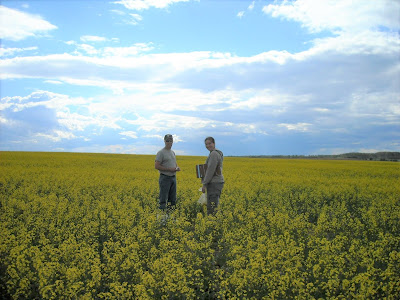
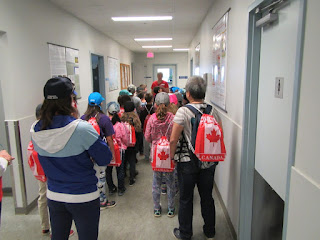
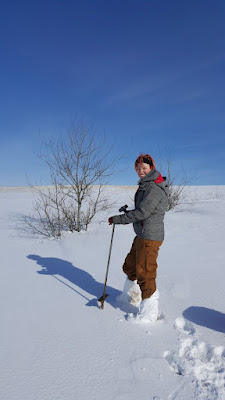
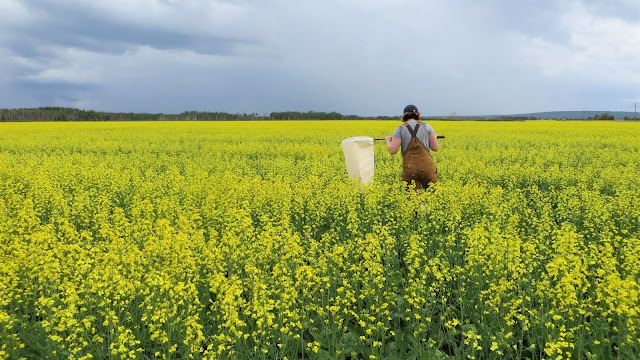
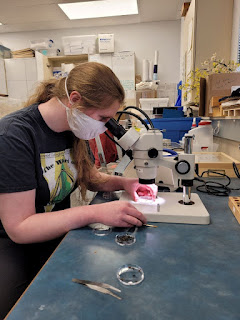
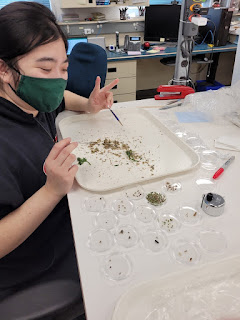
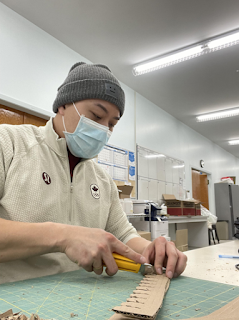
Did you know..... February 11, 2022, is the International Day of Women and Girls in Science! Our lab marked the day with a selection of photos of our team members actively performing a variety of tasks supporting research in the field of Entomology! 

Figure 1. Jennifer and Ross collecting insects in canola growing near McLennan AB in 2008 as part of the annual survey of the Peace River region (2003-present).

Figure 2. Jennifer leading a school-aged tour through the Crop Services Building at the AAFC-Beaverlodge Research farm in June 2017.

Figure 3. Amanda collecting wheat midge soil core samples from snow-covered wheat stubble near Rolla BC in April 2017. 

Figure 4. Shelby collecting a sweep-net sample in canola growing near Hines Creek AB in July 2017.

Figure 5. Tessa using the stereomicroscope to sort and identify frozen insects from sweep-net samples collected in 2021 from alfalfa.

Figure 6. Vicky hand-sorting frozen arthropods collected in alfalfa in 2021 using a paint brush.

Figure 7. Jordon constructing vial storage for long-term cold storage of ethanol-immersed pitfall trap arthropods.